
Ministers assure transparency and speedy stockpile releases


Play
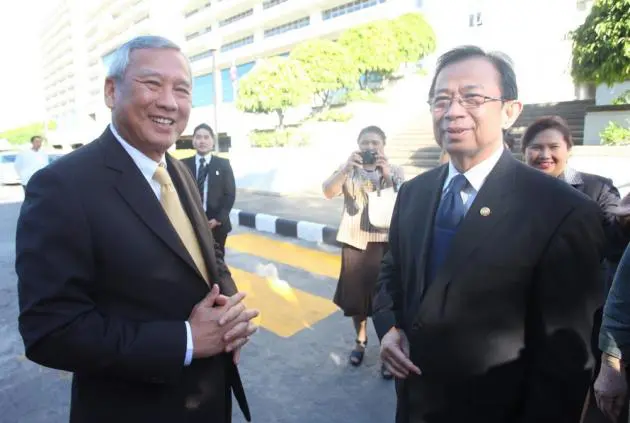
New Commerce Minister Niwatthumrong Boonsongpaisarn and his deputy Yanyong Phuangrach vowed to reduce corruption in rice pledging and releasing and to increase transparency and flexibility in rice selling to rebuild the ministry and country's image.
“Rice project management is one of my priority tasks. The ministry will consider a price that can help farmers, as well as ensure that Thai rice exports can compete and sell in the world market. Rice pledging and releasing should be more transparent. I will look for measures to prevent corruption under the project,” said Niwatthumrong, also a deputy prime minister.
The ministry targets rice exports at 8-8.5 million tonnes this year.
Taking office today, Niwatthumrong said he needs some time to restore public trust in the ministry, which has dropped due to the controversy over the rice intervention scheme.
The ministry will accelerate sales of rice to clear out half of the huge stocks from pledging, which amount to 17 million tonnes.
The government needs to unload more rice to reduce holding and operating expenses as well as to return some money to the Finance Ministry to continue subsidising rice mortgaging projects in the future.
The government still needs to support the pledging scheme because of the falling trend in world market prices. Many countries have shipped out more rice this year. Without the subsidy, the price of Thai rice would gradually decline.
Yanyong said the ministry plans to speedily release more than four million tonnes of rice from July-September so that the government can cut its spending on rice stocks and make money to send to the Finance Ministry.
The releasing price should be more flexible. It should be in line with the market price or about US$500 a tonne of white rice.
He has ordered the Foreign Trade Department to draw up a sales plan for each rice market. The releasing methods should be more open to the public and general exporters.
The government will allocate big lots of rice to major consuming countries such as Indonesia and the Philippines. The government may not directly strike government-to-government deals with buyers, but would allow private exporters to handle the government’s stocks as they are more efficient in logistics and management.
The new pledging price should be Bt13,000 a tonne of paddy rice.
“Farmers should be able to accept this price since it is higher than the market price by Bt2,000 a tonne. The government would like to set a subsidy price that can help farmers as well as allow more flexibility in rice exports for competitiveness,” he added.
