
'Asia needs visionaries'


Play
BOT chief says need for long-term strategies to remove bottlenecks
Asian leaders need to address structural bottlenecks, chiefly regarding labour and productivity, in order to achieve sustainable growth, Bank of Thailand Governor Prasarn Trairatvorakul said.
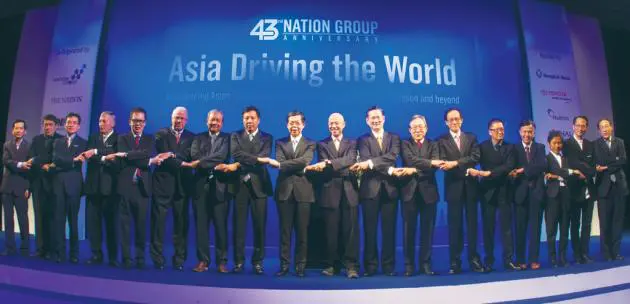
Given that long-term strategies are needed to address these bottlenecks, visionary leadership, consistency and continuity are required, he said yesterday at The Nation’s international conference entitled “Asia Driving the World”. The seminar was held to mark the 43rd anniversary of Nation Multimedia Group.
In his speech on “Asian and Thai Economies in a Volatile World”, the central bank chief said these measures would drive sustainable economic growth with meaningful effect and minimum cost for Asia.
“These three principles – visionary leadership, consistency and continuity – should be at the root of the national economic policy formulation and implementation to ensure quality public policy that can enhance the country’s competitiveness and sustain long-term growth,” he said.
In Thailand, consistency and continuity are already present in the strategic agenda. However, the problem lies in implementation. In order to address these problems, a combination of legal framework, private-sector participation and quality engagement must be included.
He noted that labour shortage and productivity were the two key things dragging down long-term growth in emerging Asia. To address this shortage, attention should be paid to problems such as the wage structure and mismatch in skills. National strategies are needed to boost productivity, as some macro policies may distort the system, he said. For instance, he said, the agricultural price subsidy measures, while serving their redistribution purposes, might inadvertently move workers away from the productive manufacturing sector to the agricultural sector, thus contributing to lower overall productivity in the economy. Low public spending on research and development, as well as insufficient protection of intellectual property rights might deter innovative entrepreneurship and hinder the moves towards a knowledge-based economy.
“The long-standing weakness of our labour market has emerged as an important bottleneck hampering potential growth. Reorienting the country’s growth strategy to focus more on skill development, innovation and productivity involves deliberate planning over a relatively long stretch of time,” he admitted.
Pointing out that most policies in emerging markets have been focused on demand-side management, he explained that the real shift of potential growth in the economy must essentially come from supply-side progress.
Prasarn noted that given the economic slowdown, Asian nations have also been given support to deal with the bottlenecks.
Growth forecast revised
The Bank of Thailand yesterday announced a revised economic growth forecast for 2013 with risks tilted to the downside mainly from the fragile global economy and the possibility of further delay in the Bt350-billion water-management plan. From 5.1 per cent, the 2013 forecast was slashed to 4.2 per cent, while the 2014 forecast was maintained at 5 per cent. Inflation forecast was revised down from 2.7 per cent to 2.3 per cent in 2013, and from 2.7 to 2.6 per cent in 2014.
Prasarn noted that despite the global jitters, Thailand’s unemployment rate remains low while income remains relatively high. The export sector should also pick up in the latter half, thanks to recovery in Japan and the United States. The low interest rate should also help spur growth. He said the central bank already has the tools to deal with volatility in capital flows. Also, despite some delays, the mega-project investment would contribute to the overall economic outlook, he added.
However, he warned that in the second half, local investors should prepare for fluctuations in global financial markets. He also said that he expects the household debt level, now at 80 per cent of gross domestic product, to affect people’s purchasing power. However, he is convinced China’s slowdown will only have a short-term effect.
Note: Vision of the “Future of Asia” by Surakiart Sathirathai, chair of the Asian Peace and Reconciliation Council, will be published on Monday. The “Business Visions 2020” gathered from the same event will be published on Tuesday.
