
Rice-pledging price 'to stay'
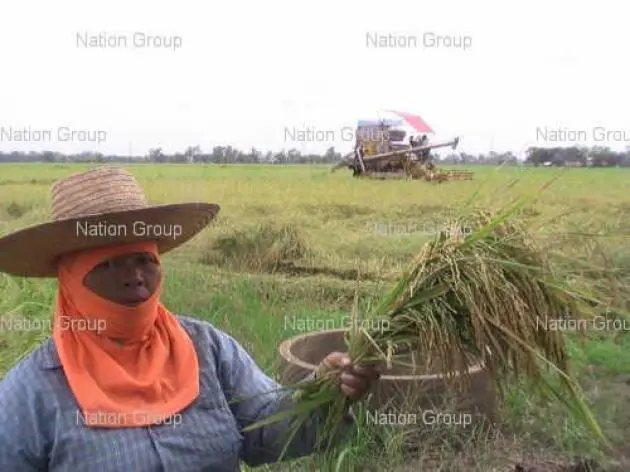


THE GOVERNMENT is expected to maintain the pledging price for the upcoming year at Bt15,000 per tonne of white paddy rice to ensure farmers' satisfaction, but the price will be lowered in the following year, forum participants were told yesterday.
Prasith Boonchuey, president of the Thai Rice Farmers Association, made the remarks at the “Answer Farmers’ Questions … Answer the Public” seminar, organised by the Rice Department in cooperation with the association.
He said that after farmers’ talks with the Internal Trade Department, the government was very likely to maintain the pledging price for the time being, as farmers have already sown their rice and planned their returns on the basis of current production costs.
Such a plan would ensure farmers are satisfied with their returns for the forthcoming year, while the government would lower the pledging price next year to maintain an adequate budget, he said.
To pledge rice at the same guaranteed price of Bt15,000 a tonne in the future, farmers would be limited to participation in the pledging scheme only once a year, instead of twice yearly. The government will also limit payments to Bt400,000 per family, he added.
“Farmers quite understand the government’s need to limit the rice-price subsidy budget. If the government wants to lower the pledging price, it can be done, but the revision needs to be based on lower production costs and a plan to help farmers sell their production to the market in accordance with market prices,” Prasith said. He urged the government to help promote rice quality, production and develop marketing plans to ensure that farmers get a good price without the need for government subsidies.
The association projects that about 15 million tonnes of paddy will enter the next harvest season (2013-14), starting in early October.
The association chief also called on the government to launch a crop-insurance scheme and set up a farmers’ welfare |fund to help them after they retire.
Changing rice seeds
Chairit Damrongkiat, director-general of the Rice Department, said the government planned to promote changes in the rice seeds used by farmers across the country, to develop overall rice quality. This will cost Bt10 million over the next five years.
There has been no major change in the rice seeds planted by farmers since the 1980s. Normally, rice seeds can be kept for three to five years, after which time they begin to mutate, he said.
The production of seeds has also been increased, from 300,000 tonnes last year to 620,000 tonnes this year, he said, adding that the department will continue to promote seed production to serve demand of 1 million to 1.2 million tonnes a year.
Moreover, the department will encourage farmers to use low-chemical substances for rice cultivation, as well as help them lower production costs.
The Rice Department targets a reduction in production costs from the current average of Bt8,371 a tonne to about Bt6,490 a tonne.
Production costs should ultimately fall to Bt1,000-Bt2,000 a tonne, and the yield should also be increased from the current 439 kilograms per rai (2,744kg per hectare), he added.
Chairit said Thailand had a low yield due to a lack of irrigation areas, with about 70 per cent of total rice plantation of 70 million rai (11.2 million hectares) being outside irrigation areas.
According to a recent study by the Thailand Development Research Institute, the rice-pledging programme will increase public debt by an average of 4 per cent per annum.
Research undertaken by MR Pridiyathorn Devakula found that without the rice-pledging scheme, total public debt is expected to increase from Bt4.9 trillion at the end of September 2012 to Bt8.6 trillion in September 2019.
However, with the losses accrued from the scheme, public debt is expected to surge to about Bt10.3 trillion by September 2019.
