
Aerators breathe new life into Kalasin fish farmers


Play
Rapid climate change, drought made survival of fish near impossible
Rapid environmental change and drought have caused fish farmers in Kalasin province in the Northeast to switch to using paddle-wheel aerators in a bid to generate sustainable income – and the strategy has certainly proved a successful one.
For decades, fish farmers in the Lampao Dam area, which is the main water resource in the province and nearby areas, have suffered from losses as they cannot operate productively due to the low water level and poor water quality, which prejudice the survival of their fish.
With fish farming around the dam restricted to the use of cages, a water level below 8 metres is not good enough to farm and ensure their fishes’ survival.
Consequently, they have had to follow the water course between 2 and 10 kilometres from their homes in order to find deeper and better-quality water in which to operate.
The oxygen ratio in the water is the most important factor for the survival of fish raised in cages. If the sky is totally cloudy before a rainstorm, or during a period of extremely high temperatures and drought, there is low oxygen production in the water, which in turn affects the fish in a farm’s cages.
Moreover, the Northeast is the most drought-prone region in the Kingdom – a fact of nature that Kalasin cannot escape, with Lampao Dam reservoir having fallen to a very low level of 279 million cubic metres in late June, accounting for only 14 per cent of its capacity of 1.98 million cubic metres. The lowest level on record was a mere 9 per cent of capacity, several years ago.
The falling water level prompted many farmers to temporarily stop operations in order to avoid further losses.
Methee Umpaipis,46, owner of a fresh-fish business in Kalasin, and a leading fish trader and integrated animal-feed and equipment distributor in the province had to find a way to keep customers and reduce his own losses. His customers get short-term credit to manage their farms.
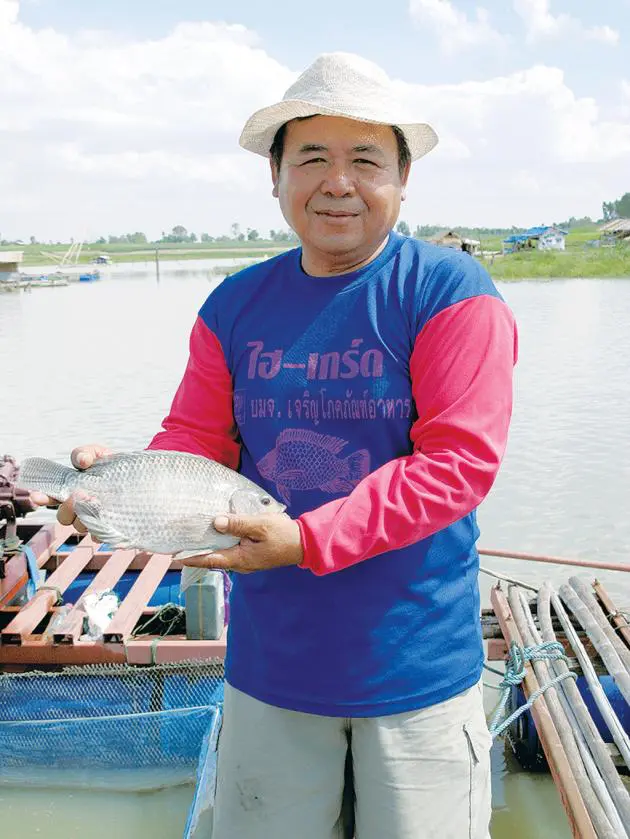
Methee, who is also head of the Fish Farmers of Lampao Club, has to take care of 127 members with 4,000 cages and a combined production of 24-25 tonnes per month. They farm two types of fish: Nile tilapia and red tilapia.
Their production is distributed not only within Kalasin, but also in the neighbouring provinces of Udon Thani, Surin, Roi-et and Khon Kaen.
Methee, who also has his own fish farm, was determined to minimise the risk of more serious problems for the future of the local industry.
“Some farmers had lost most of their fish due to low water quality, which is mainly the result of low oxygen level, so we needed to find a way out for sustainable farming,” he said.
To solve the problem, he invested his own money and worked closely with Charoen Pokphand Foods (CPF) in an attempt to ensure the fish farmers’ survival, and that of his own farm, in the long run.
Based on the practice used for years in shrimp farming, CPF suggested that he use paddle-wheel aerators to oxygenate the water around the fish cages, initially as a demonstration farm.
After following this advice, Methee began to make a high profit, in sharp contrast to other fish farmers in the area, who continued to make losses by using traditional farming methods.
Moreover, Methee and fellow fish farmers in his group have had to move only 2km from their homes in order to farm, compared with up to 10km for many others.
In using its aerators, the company supplying the equipment also suggested that farmers change their feeding schedule, with more feeds per day but a lower quantity each time.
Return on investment
Methee said each farmer’s production costs would rise by Bt1 per kilogram due to the installation of a paddle-wheel aerator. However, the return of investment in terms of fish quality and survival ratio would create attractive benefits.
Narong Poolonkaew, a successful fish farmer in the group, said the paddle-wheel aerator’s oxygenation of the water in the cage meant the fish could breathe and develop far better, on top of which a more regulated feed was more amenable to the fish.
“I’m now happy that I have certainty of income even during drought, when it’s a tough time to farm fish,” he said.
He now has a total cost of around Bt500,000-Bt600,000 for operating 40 fish cages, and has managed to sell Bt700,000-worth of produce per crop in five months. The fish farmers have five crops every two years.
Meanwhile, Kittipos Ngam-charoen, assistant vice president of CPF, said the company wants to encourage sustainable fish farming in other provinces that face similar water-quality problems to those in Kalasin.
Farmers in Sakhon Nakhon, for example, are being encouraged to apply the aeration technique in order to reduce risk.
Moreover, the feeding time should also be adjusted to more than five or six times per day, he said.
“The technique will support farmers to operate throughout the year, despite drought,” said Kittipos.
