
Thailand's FDI in Asean 'needs boost'


Play
Failure to invest in region 'hits competitiveness of local firms'
Thailand is lagging in direct investment in Asean, despite facing a labour shortage, limited natural resources and rising land prices.
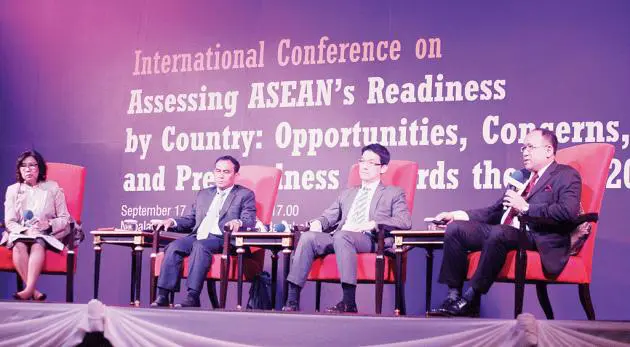
Local companies are not heavily investing in Asean, probably because they consider some countries as too risky, Manop Sangiambut, executive vice president of Siam Commercial Bank (SCB), said on the sidelines of an international conference yesterday.
The ranking of Thailand as a direct investor in Cambodia, Myanmar and Vietnam is falling, unlike the rankings of China, Japan and South Korea, which are pouring huge sums into Asean, he said.
Thai state agencies should increase their role in providing information on the markets and regulations of each country in Asean, he said.
Companies from China, Japan and South Korea are active in Asean because their governments have promoted outbound investment through incentives, Manop said.
Thailand’s foreign direct investment (FDI) ranking is likely to keep falling if its companies are unable to secure a foothold in Asean through investment, he said, warning that some labour-dependent businesses will lose competitiveness if they dare not move their operations to neighbouring countries.
Thai companies need to invest in other countries to avoid the problems of labour shortages and matured growth at home.
SCB, which has a network in Cambodia, Laos, Myanmar and Vietnam, facilitates Thai businesses in Asean through trade finance services, rather than project finance, in line with the smaller volumes of FDI.
Mekong Subregion
The Greater Mekong Subregion is a prime destination for Thai companies because gross domestic product growth in those countries excluding Thailand is higher than 5 per cent.
“Myanmar’s reform is positive for business, and the country has demand for investment in energy, including power plants, while Cambodia is a country that welcomes foreign investment and Vietnam’s economy is recovering,” he said.
Singapore is often viewed as the star when it comes to who stands to benefit the most from the Asean Economic Community (AEC)’s scheduled launch in 2015. However, Singapore’s history of economic reforms and competing with foreign businesses since the mid-1960s does not guarantee an easy ride for the petite city-state.
“There is still more to do,” Prof Chia Siow Yue, a senior fellow at the Singapore Institute of International Affairs, told the same international conference.
Singapore may have the highest per capita GDP in Asean, but it has the smallest amount of land and natural resources, relying very much on its foreign workforce.
It is aware of the need for hard work and sweat when it comes to competing with foreign businesses to survive.
Quality services, education and infrastructure development are the core businesses for Singapore, where good quality comes before good price.
This is the key in competing with other countries, such as in the case of the medical industry, where Singapore pits its highly skilled personnel and technology against the lower-cost services offered by Thailand and Malaysia.
Singapore is playing a complementary rather than a competitive role for its neighbours, the professor said.
Over the years it has assisted in exporting products to the world for its fellow Asean countries in industries such as rubber and energy.
“Most Singaporeans do not want to leave the comfort of their home country,” he said.
Families do not want to disrupt their children’s education or risk having a spouse leaving their work at home.
In fact, one-third of the workforce is foreign, consisting of both low- and high-skilled labour, and Singapore is investing more in the region.
Singapore has made more than 1,000 foreign direct investments in Vietnam, becoming the second-largest investor there.
It is hoped that joint ventures in constructing five industrial parks in Vietnam will draw even more FDI to the country. Nearer to home, many Singaporean businesses have expanded or relocated to southern Malaysia.
So perhaps Singapore is not a hungry “Merlion” ready to devour the whole of Asean, but rather a “complementary” friend to Asean economies, trade, goods and services after all.
