
Innovation needed for higher productivity: Prasarn
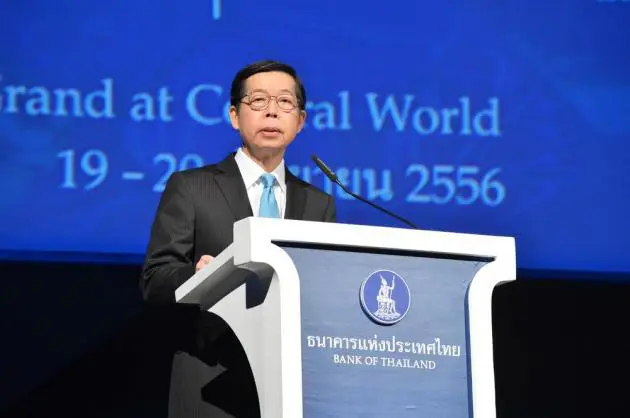


Bank of Thailand (BOT)'s governor on Thursday highlights the urgent need for technology innovation to increase output or added value, as well as the allocation of resources to higher-productive sectors.
In his keynote speech at the BOT Symposium 2013 under the “Lifting Barriers to Sustainable Growth” theme, Governor Prasarn Trairatvorakul said that this will help the country cope with a major challenge that may disrupt the economic sustainability.
"That the agricultural sector employs 40 per cent of workforce but generates about 10 per cent of the GDP, against the 15:40 ratio in the manufacturing sector, shows the different efficiency of resource exploitation in the two sectors. It also demonstrates a room that new technology can be used to lift up the productivity," he said.
Prasarn expressed his concerns over the country's basic economic foundations, which may not be sufficient to sustain economic growth. This is a crucial issue as Thailand's economic growth rate weakened from 9 per cent per annum before the 1997 economic crisis to 4 per cent at present. Meanwhile, the country's per-capita income has remained at 15-20 per cent of the US rate for years, representing an unimproved cost of living standard. Meanwhile, starting from the same level, the per-capita income of countries like Malaysia, South Korea and Taiwan has increased.
He quoted a World Economic Forum survey in the last five years in which Thailand’s 28th rank dropped to 37th while Indonesia improved from 54th to 38th and the Philippines climbed up 12 ranks.
Thailand’s major challenges are political instability, corruption, a lack of preparedness in technology and education while monetary and financial policies were too restrictive to boost the country’s economy, he said.
The government must improve production capability and efficiency to cope with negative factors and sporadic volatile impact if it wants to boost Thailand’s economy, said Prasarn.
He said Thailand describes itself as the hub of Southeast Asia given its role as the manufacturing base for significant industries and good trading partners, but it has not made full use of the strength for economic expansion.
Thailand needs a major change, especially the private sector which much boost its manufacturing capability, while the Thai workforce must adjust itself to new production technology with the government’s support, he said.
He also called on Thai people to be open to diverse attitudes and create a value standard that excludes corruption and is in favour of good governance.
