
US must solve gridlock as soon as possible: IMF chief


Play
International Monetary Fund Managing Director Christine Lagarde urged the United States to resolve the political gridlock as soon as possible, before this sends negative repercussions on the global economy.
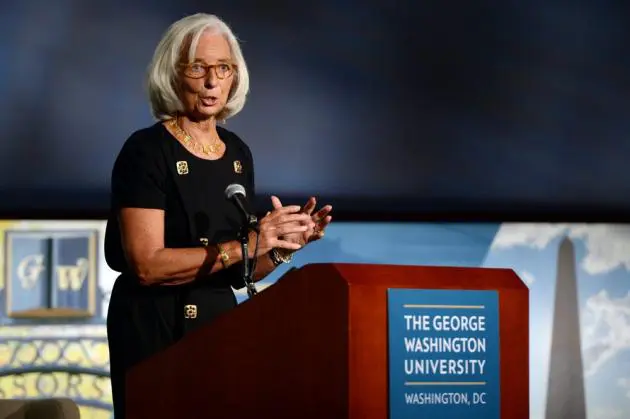
"It is “mission-critical” that this be resolved as soon as possible," she said in the speech entitled "Managing the New Transitions in the Global Economy" to George Washington University, Washington DC, on October 3.
On fiscal challenges that global economies are facing, she said the US needs to "slow down and hurry up”.
"By that I mean less fiscal adjustment today and more tomorrow. That means replacing the sequester with more back-loaded measures that do not hurt the recovery. At the same time, the U.S. needs to do more to make debt sustainable down the road - by containing the growth of entitlement spending and raising revenues.
"In the midst of this fiscal challenge, the ongoing political uncertainty over the budget and the debt ceiling does not help. The government shutdown is bad enough, but failure to raise the debt ceiling would be far worse, and could very seriously damage not only the U.S. economy, but the entire global economy."
She also said that Japan also needs a credible plan to bring down its debt, which is approaching 250 per cent of gross domestic product (GDP) - and amounts to about US$90,000 for each of Japanese.
"The initial consumption tax increase is a welcome first step. Entitlement reform is the next one. Without these policy fundamentals, any gains made so far could easily melt away," she said.
She added that the fiscal and financial efforts must be complemented by structural reforms - to make sure that policies to boost demand are supported by policies to boost supply.
For the Euro Area, the IMF estimates that comprehensive and coordinated reforms of product and labor markets could boost GDP by 3.75 per cent after five years. For Japan, increasing female participation in the labour force to match the G7 average would boost per capita GDP by 4 per cent by 2030.
"We should remember that this group of economies accounts for about 40 percent of world GDP. So what happens in these regions has profound implications for the rest of the world. This makes engagement with the international community all the more important. National policies alone cannot do it."
Several economic issues are to be discussed at this year's IMF/World Bank annual meeting scheduled for October 11.
