
Kingdom stays 18th in WB report on business-friendly economies


Play
Singapore retains top spot as Malaysia jumps
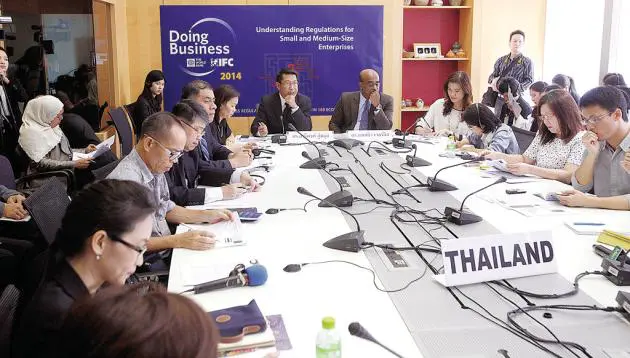
Thailand retains its 18th-place ranking among business-friendly economies, while one official claims the authorities can get the country into the top 10 in just two years.
Singapore continues to be the most business-friendly in the world and Malaysia jumps from 12th to sixth, according to the “Doing Business 2014” report released yesterday by the World Bank and the International Finance Corporation.
The report analyses regulations that apply to an economy’s businesses during their life cycles, including start-up and operations, trading across borders, paying taxes, and resolving insolvency.
The rankings are based on 10 indicators and cover 189 economies, the World Bank said.
Thailand has done well in protecting investors, providing electricity and dealing with construction permits. But it does poorly in other indicators such as starting a business, getting credit, and resolving insolvency.
Because of a web of regulations, it takes 27.5 days to start up a business in Thailand, compared with just three days in Singapore.
Small and medium-sized enterprises have faced difficulty getting credit from local financial institutions. In this category, Thailand scores considerably lower than Malaysia.
Resolving insolvency is very time-consuming in Thailand, taking 2.7 years compared with Asia’s best practice of 0.6 year in Japan.
Compared with the previous “Doing Business” report, Thailand made paying taxes less costly for companies by reducing employers’ social-security contribution from 5 per cent in 2011 to 3 per cent applicable in January-June 2012 and 4 per cent applicable in July-December 2012.
Over the past eight years, Thailand has implemented 13 business regulatory reforms in six out of 10 area measured by “Doing Business”, said Mikiko Imai Ollison, the World Bank’s private-sector development specialist.
Thailand’s No 18 ranking is the same as it was in “Doing Business 2013”, while Singapore has remained on the throne for eight consecutive years.
“Thailand has made [improvements] in business regulation but other countries have done much better, so Thailand needs even to do more,” Ollison said.
Meanwhile, Areepong Bhoocha-oom, secretary-general of the Office of the Public Sector Development Commission, said the Thai government was implementing four key efforts to improve the business-friendly economy. To facilitate import and export, it is developing a single-window service. The government will also upgrade its information-technology system to provide better service to business and people.
The Thai government will also reorganise its payment system as well as make it much easier for investors to put their money into this country, he said.
“With our re-engineering efforts, our ‘Doing Business’ ranking can be upgraded to be among the top 10 in the next two years,” Areepong said.
