
HM's sufficiency theory wins farmer FAO award


Play
Jarun now shares his know-how with fellow villagers, agriculture students
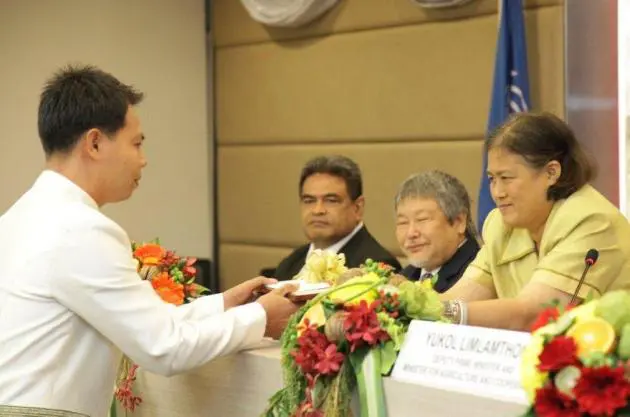
Jarun Jaroensab, the first Thai farmer to receive the Asia-Pacific Model Farmer Award from the Food and Agriculture Organisation (FAO), took to farming after learning about His Majesty’s “sufficiency theory”.
“As a child growing up in Ratchaburi province, I wanted to become a farmer. But as a teenager, I thought a career in the civil service would be more stable financially. There was just one problem, my parents could not afford to send me to university because they had mortgaged their 5-rai farm and were saddled with debt,” Jarun said after receiving the award.
Yet, despite these challenges, Jarun was determined to succeed. His instincts told him there had to be a way out of debt through farming, so he did some research and found a book on His Majesty’s sufficiency theory.
The sufficiency theory advocates a diversified approach to farming, rather than sticking to one crop, and encourages what are essentially organic methods for sustainability and freedom from loans.
Jarun decided to adopt the ideas and turned to Kasetsart University and Department of Agriculture for advice on implementation of the practices. He later shared his knowledge with other farmers in his village of Rang Si Mok.
Initial yields when using organic methods were low. “It was tough and many of my neighbours gave up.”
But Jarun continued and before long, his yields were high and his farm was self-sufficient. Nonetheless, he and his neighbours were still at the mercy of the market.
They grew rice and other crops in the belief that demand was strong, but all too often, oversupply brought the prices down.
So Jarun realised he had to make wiser choices about what to grow as well as come up with a marketing plan to sell effectively. While hunting for ideas, he decided to seek a job at one of Thailand’s largest agro-industrial companies. However, since he did not have a degree, he only landed the post of a janitor. But Jarun decided to make the most of it. He watched, listened and learned. After three months he developed a business plan, quit his janitor job, and began growing organic asparagus and baby corn to sell at a market just north of Bangkok.
It wasn’t long before exporters discovered Jarun’s high-quality organic vegetables, and with his knowledge about marketing, packaging, food safety and international standards he was ready for the big move. Now the problem was that his farm, which had expanded to 30 rai, was not big enoughy to meet the demand.
So Jarun began training other farmers. He is also a member of working groups on sustainable methods at two universities, and chairman of the Safe Fruit and Vegetable Exporters Group in his district.
He also managed to put himself through university, earning a degree in political administration.
“I want to understand how to make government work better for farmers,’’ he said, adding that he had no political ambitions.
Jarun is now one of four farmers to receive this year’s Model Farmer Award. The award winners were Sithar Dendup from Bhutan, Myrna Conmigo Asor from the Philippines, and Malia Sosefo Guttenbeil from Tonga.
The awards are handed out every year as part of the observance of World Food Day, which this year marked the 68th anniversary of the founding of FAO in Quebec City, Canada on October 16, 1945. The theme for this year’s World Food Day was Sustainable Food Systems for Food Security and Nutrition.
A food system is comprised of the environment, people, institutions and processes by which agricultural products are produced, processed and delivered to consumers. Every aspect of the food system affects the availability and accessibility of diverse, nutritious food and the ability of consumers to choose healthy diets.
According to the FAO, the Asia-Pacific region has made good progress towards achieving the Millennium Development Hunger Goal by 2015 – moving towards eradicating hunger by 2025 through the implementation of the Zero Hunger Challenge.
However, malnutrition remains a serious concern, said Hiroyuki Konuma, FAO’s assistant director-general and Asia-Pacific representative at a World Food Day event in Bangkok. Globally, one in every eight persons is undernourished. One of four children in the world under the age of five is stunted, while 165 million of these children are so undernourished they never reach their physical and intellectual potential. Some 60 per cent of the undernourished people live in the Asia-Pacific region.
