
Spectrum master plan to be revised next year


Play
As watchdog aims for affordability for all
The National Broadcasting and Telecommunications Commission next year will revise the spectrum master plan to ensure that future mobile broadband services are affordable for all users and to serve the long-term investment of telecom operators.
It also aims to serve surging demand for mobile broadband service, NBTC chairman Thares Punsri told a seminar on time-division long-term evolution (TD-LTE) at the “ITU Telecom World 2013” event, which kicked off yesterday in Bangkok.
The NBTC’s revision of the master plan is in line with its plan to auction 1,800MHz spectrum bands next year to provide 4G wireless broadband service. It will take these bands from TrueMove and Digital Phone Co, whose concessions expired in September this year.
Speaking at the same forum, Advanced Info Service (AIS) chief executive officer Wichian Mektrakarn said Thailand needed more bandwidth and new mobile technology to meet rising consumer demand.
He estimated that the market value of overall mobile services in Thailand would reach Bt214 billion this year – a rise of 7 per cent from last year’s level.
The value of the mobile-device market is estimated to be Bt52 billion, some 15 per cent higher year on year.
The watchdog awarded 2.1GHz spectrum licences to each of the three bid winners – AIS’s Advanced Wireless Network, DTAC TriNet of Total Access Communication (DTAC), and True Corp’s Real Future unit – last December, following which they launched the service early this year.
Real Future is the only operator currently offering both 3G and 4G service on the 2.1GHz band.
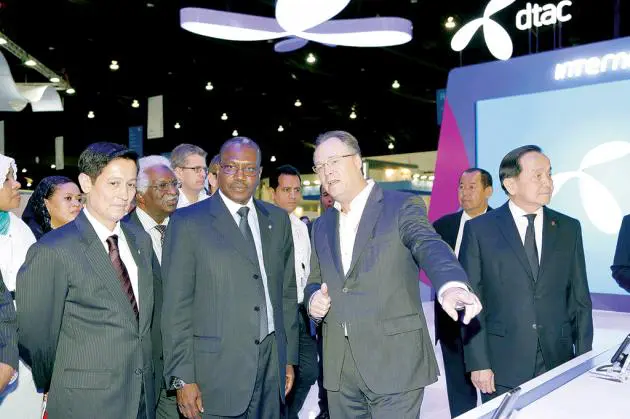
The ITU (International Telecommunications Union) event, which runs until Friday at Impact Muang Thong Thani, has a central theme of “Embracing Change in a Digital World”.
It is jointly being held by the Information and Communications Technology Ministry, the NBTC and the Thailand Convention and Exhibition Bureau.
Sheikh Abdullah Bin Saud Al Thani, chairman of Qatari telecom operator Ooredoo, said in his opening speech about embracing change that change had been a constant in the telecom industry, and one that had driven how the operators work.
To survive and thrive in this industry, companies have needed to be nimble, innovative and capable of responding to change, he said.
Ooredoo is one example of companies having adapted and changed, he added. Back in 2005, it was a one-country operator serving fewer than half a million people in Qatar. It saw the need for growth and seized opportunities in its own region, as well as in North Africa and Southeast Asia.
Having already grown its customer base to more than 93 million, Al Thani said the company was now making plans to enhance its profile in order to help take the data revolution to another level in Asia, and across its markets.
He stressed, however, that all parties had to do a better job of shaping the future, rather than merely responding to it, by becoming active investors in new ideas, new thinking and new approaches that will help customers in their daily lives.
Ooredoo and Norway’s Telenor are two global telecom operators that have recently won commercial licences to operate telecom service in Myanmar.
Hamadoun I Toure, the ITU’s secretary-general, said the duty of all parties was to bring connectivity and technology to all people, and to put such technology to good use.
Regulators must adapt to the new broadband reality, to an increasingly open environment, and to converging industry sectors, he said, adding that operators must also invest in infrastructure, create new services and develop new business models.
