
Too early to assess impact of latest anti-govt move


Play
Prolonged or violent conflict will hurt business amid sluggish economy: economists
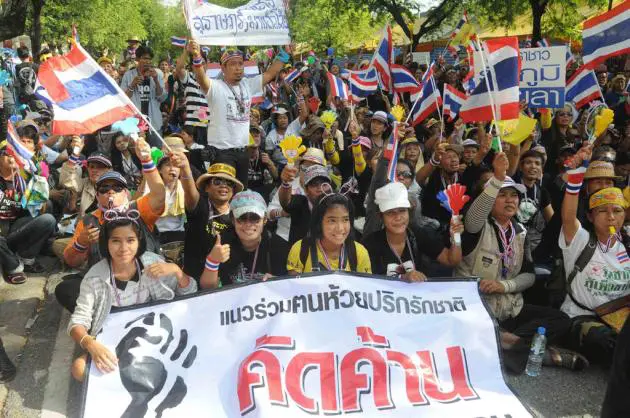
It is too early to evaluate accurately the impact of the occupation of the Finance Ministry compound and other government offices by anti-government protesters but it could affect investors’ confidence in Thailand and might trigger more capital outflows, economists say.
Charl Kengchon, managing director of Kasikorn Research Centre, said the protests were developing quickly and it was hard to predict what would happen. But the occupation of state agencies’ buildings might affect foreign investors’ confidence.
He said Thailand currently faced other major risks besides local political instability, including the possibility that the US Federal Reserve would taper its quantitative easing measure soon. December is also the month when foreign investors rush to sell bonds and shares to adjust their portfolios for the new year. The fast-changing political activism might be a catalyst for foreign capital to flow out of the stock and bond markets.
Benjarong Suwankiri, head of TMB Analytics at TMB Bank, also said it was hard to evaluate the impact of the occupation, as nothing quite like this had happened before. Analysts will just have to wait for a while to see what the effects are.
If the occupation is prolonged, it could affect consumer spending, which has already slowed down for other reasons. He believes that foreign investors are evaluating the situation.
Despite the political unrest, he forecasts that gross domestic product will grow by 3 per cent this year. However, the biggest concerns are violence and the spillover impact on the planned Bt2-trillion infrastructure mega-project, which could pull down economic growth next year.
The chairman of the Thai Bond Market Association expects an adverse impact on the economy and business if the current political uncertainty is prolonged.
Bandid Nijathaworn said money markets were watching the situation, uncertain how long it will drag on and how much impact it will have on the economy, particularly on foreign investment and tourism. Recently, some countries have issued travel advisories for their citizens planning to travel to Thailand.
“All businessmen want a clear resolution to get rid of business uncertainties. There have been a lot of comments on what they want to see,” Bandid said.
He said Thailand’s long-term bond yield had risen by 0.3-0.4 per cent since the beginning of the year, which might have reflected foreign bond yields’ rises. Thailand’s short-term bond yield eased in line with monetary policy.
“We have to look at costs consistently, whether they remain the same or are rising. [If they rise,] that means there are concerns. We need to monitor this,” he said.
The SET Index yesterday closed at 1,352.86 points, 6.21 points or 0.46 per cent lower than Friday. Investors in the Stock Exchange of Thailand were spooked by the growing protests in Bangkok. Foreign investors have remained net-sellers of Thai shares. Year to date, foreign net-sell has exceeded Bt136 billion.
Thailand was the only market in Asia that failed to rise yesterday, while others enjoyed benefits from Wall Street's seventh straight week of gains and a nuclear deal between world powers and Iran.
Sit down and talk
Meanwhile, the Thai Chamber of Commerce (TCC) pleaded for all parties to sit down and talk in an effort to find solutions.
Kalin Sarasin, secretary-general of the chamber and of the Board of Trade of Thailand, expressed concern that the spreading protests would have a negative impact on businesses that are already struggling with the slowdown in the economy.
Images of the political gatherings could also undermine confidence of foreign investors, and tourists may avoid travelling here, he said.
He conceded that it was difficult to assess the political development accurately enough for the TCC to issue a statement, but from his personal standpoint, he could see no solution to the political row.
“We have to make assessments on a daily basis. The number of protesters has been rising, but the government has remained quiet. We don’t know what will be the end of this story. We have been closely monitoring the situation,” he said.
He said the government might end up having to delay several projects and the economy could stagnate.
The government is scheduled to hold a regional meeting of the Public-Private Joint Committee, at which several projects are set to be approved, in Songkhla on Friday.
“The government has not yet confirmed [that the meeting will go ahead]. There remain concerns that there could be protests in the area, and that it may not be safe for no fewer than 100 government and private-sector representatives to attend the meeting in the South,” Kalin said.
He suggested that the most proper solution was for all parties to negotiate peacefully, instead of holding stubbornly to their own points, as conflict would not benefit the country in the long term.
David Korunic, chief executive of Krungthai-AXA Life, said the impact of the political row on the insurance market would be minimal and short-term. The Thai economy has high ability to bounce back from adversity, as evidenced by how quickly it recovered from the 2011 flood disaster and the political turmoil in 2010. He revealed that the sale of insurance in Bangkok had slowed down in the past couple of months but so far there had been no real impact on the company’s revenue.
Natee Sukonrat, chairman of the broadcasting committee of the National Broadcasting and Telecommunications Commission, said that despite the overheated political situation, the NBTC was sticking to its plan to auction 24 commercial licences to operate terrestrial digital TV either late next month or early in January.
Yoo Chienyuenyongpong, president of the Land Transport Federation of Thailand, said the spreading protests had affected traffic but there was still no impact on product transport and distribution.
None of the federation’s members have reported any obstacles or other problems, he said, though they expect some impacts on the transport and distribution of products to shops in Bangkok if the protests are prolonged for another week. After that, the federation would hold discussions on resolving such problems, he said.
At present, products are transported and distributed by several methods. Deliveries are made several times for convenience stores at night or in the early morning; distribution centres serve
modern-trade stores; and Bangkok’s Skytrain carries medicinal products to hospitals.
“We will analyse on how to transport and distribute products if traffic problems remain for another week,” Yoo said.
