
Flood woes 'need to be resolved'


Play
Economists say problems need to be addressed and fast-trains discussed
China’s imports are expected to pick up slightly in August from July but Thailand should focus on addressing the escalation of flood problems, plus reviving discussions with Beijing on the fast rail programme, and developing value-added products rather than depend on the import rate of major trading partners for export growth, economists said last week.
Thailand should make the most out of its economic potential and geographical advantage by resuming talks with China on the high-speed rail project soon as that would ensure that the country reaps full benefits from China’s investment in the region, said Uwe Parpart, executive managing director and strategist at Reorient Group, a boutique investment firm in Hong Kong.
“Thailand should quickly revive discussions with China on the fast rail programme since China wants to build a fast rail from Beijing to Istanbul and Thailand would greatly benefit from such development,” he said.
“It’s too narrow to just look at a few more grains of rice to be exported, since the country should be making the most out of its strategic economic potential.”
The National Council for Peace and Order (NCPO) is studying the plans for the high-speed railway, which is not part of the Bt2.4 trillion package of infrastructure projects that they approved last month.
China trade surplus may be thin
Steve Wang, research director and chief China economist at Reorient Group, expects that China’s foreign trade surplus last month should be thin and that the bright outlook for foreign direct investment in China should contribute to a slight increase in imports last month.
China’s imports fell 1.6 per cent in July year on year, following a 5.5-per-cent expansion in June, but Reorient expects the country’s imports to rebound slightly last month and finish the year with growth of 5.2 per cent to US$170.5 billion.
Korbsak Phutrakul, executive vice president of Bangkok Bank, said China is in the midst of economic adaptation and policy changes that are aimed at getting rid of their protracted internal problems such as bad debts.
They will be in the process of cleaning up the government and trade balance sheets for the next two years, which means their intended slowdown of economic growth will continue for some time.
China takes 10-12 per cent of Thailand’s exports, so an import slowdown there will inevitably affect the export sector here, while Chinese firms are also looking to expand outside their country, which means that market competition from Chinese companies in this region will increase in the coming years.
According to the Bank of Thailand’s website, Thai exports to China dropped to $5.84 billion in the second quarter of this year from $6.52 billion in the first quarter and $7.64 billion in the last quarter of last year.
“Thai firms have to look for new markets for trade and the CLMV (Cambodia, Laos, Myanmar and Vietnam) countries are one of the most attractive destinations right now, but they must hurry,” Korbsak said.
Export sector structural problems
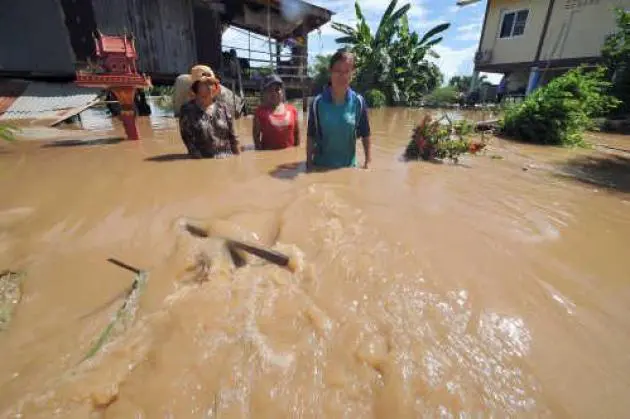
Thailand’s export sector has structural problems and there are underlying problems that have not been widely talked about including the hike of the minimum wage to Bt300, which was done too fast, and the escalation of the flooding problem in recent years.
The hasty hike of the minimum wage prompted manufacturers to move to places where labour is cheaper, which means they do not bother to upgrade existing production facilities back in Thailand.
That has led to a lack of technological advances in some industries, which eventually contributed to the slump in the country’s exports of information and communications technology and agriculture products.
About 73.9 per cent of Thailand’s exports to China are industrial products, 17.8 per cent are agriculture products and 6.5 per cent are minerals and energy products, according to the Commerce Ministry’s website.
The escalation of flood problems in a country deemed as natural disaster-free, such as Thailand, is also a factor deterring businesses from solely investing in the Kingdom and propelling them to find a second production site in another country, he added.
Chirathep Senivongs Na Ayudhya, spokesman of the central bank, said the slowdown of imports from major trading partners and the impact from exchange rates are marginal factors and the export sector should concentrate on upgrading its structure by improving the quality and value of its products in order to increase the competitiveness of its goods.
Declining exports to China
Q2 2014 Q1 2014 Q4 2013 (US$ bn)
5.84 6.52 7.64
Top three Thai exports to China (%)
Industrial products 73.9
Agriculture products 17.8
Minerals and energy products 6.5
Sources: Bank of Thailand and Commerce Ministry websites.
