
Double A chief steals the show with case study at summit


Play
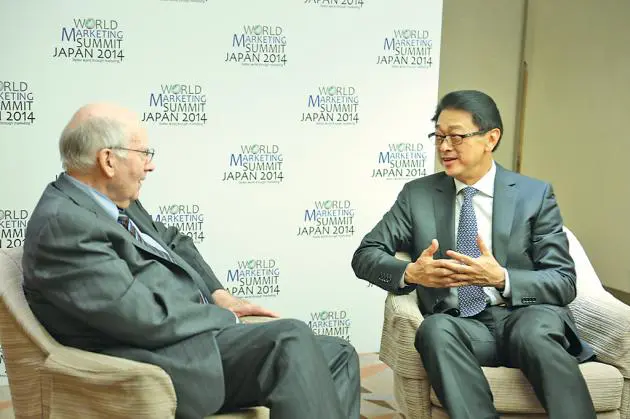
At the September 24-25 "World Marketing Summit 2014" in Tokyo, a Thai company's CEO managed to steal the show with a case study that was endorsed by Professor Philip Kotler, the world-renowned marketing guru.
On stage, Yothin Dumnernchanvanit, president of Double A (1991) – the producer of Double A and related brands of copy paper – won loud applause from the audience at Tokyo’s Grand Prince Hotel after presenting his case study on innovation’s role in differentiating commodities like paper.
According to Kotler, the most costly mistake for an average product is great marketing, as sales might increase in the short term, but consumers will never trust you again.
“Trust is at the heart of every enduring marketing success story. A company has to build a solid reputation through innovation, branding and future-driven-marketing,” he said.
Kotler said one of his philosophies is to use marketing as a tool for a better world, and Double A is probably one of the success stories in the sense that the product quality is great, so it can fetch a premium price for a commodity like paper.
In addition, the company manages to support poor people in Thailand to earn extra income from planting trees as raw material for paper production.
In other words, it could be said that the firm is socially responsible with an innovative marketing and branding approach, said the guru.
If you asked Kotler what comes next after “Marketing 3.0”, he wouldn’t hesitate to say: “Cultural marketing”, plus the use of abundant data for deeper customerisation and personalisation.
In other words, consumers in sophisticated markets will want to satisfy higher needs as their basic needs become secondary. This means they will pay more attention to social, economic and environmental impacts – the so-called “self-actualisation” needs.
For Yothin, his paper-business model is founded on the principles of environmental, economic and social sustainability that fit Kotler’s notion of higher consumer needs.
First, the company ensures that the source of raw material is sustainable by investing Bt200 million-Bt300 million per year in biotechnology research and development, that produces uniform eucalyptus trees suitable for paper production.
Secondly, Double A aims to promote social harmony by helping more than 1.5 million rural households to earn an additional combined income of Bt5 billion per year in total from planting paper trees.
Thirdly, the business model promotes self-sufficiency, since all the waste from paper production is used as fuel for electricity generation within the factories, as well as in the nearby community.
As a significant global copy-paper brand, Double A’s products are on sale in more than 120 countries, generating a combined revenue of more than Bt20 billion per year.
Besides Double A, Yothin is also the president of National Power Supply, a producer of electricity and sustainable renewable-biomass power, using the waste from paper production as the fuel.
