
High oil costs drag Songkran spending to its lowest in 4 years
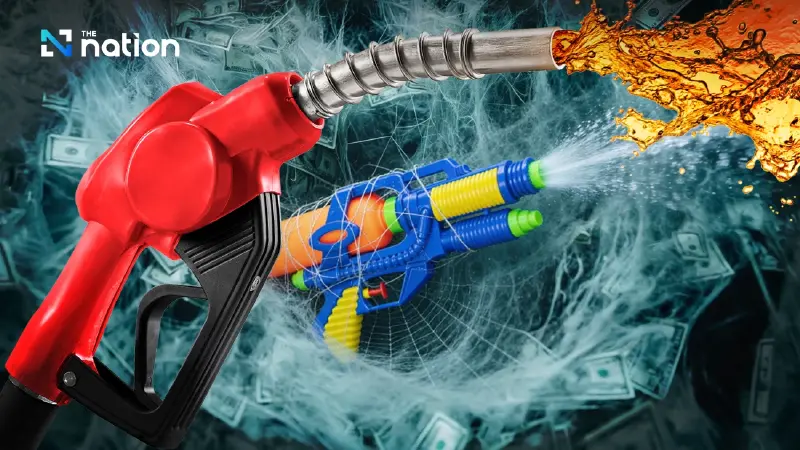


A UTCC survey forecasts THB129.649 billion in Songkran spending, down 3.7% from last year, as higher fuel costs make consumers more cautious.
- Projected spending for the Songkran festival is THB129.649 billion, a 3.7% decrease from the previous year and the lowest level in four years.
- The decline in spending is directly attributed to high oil prices, with crude oil at US$110 per barrel, which has triggered a transport crisis and made consumers more cautious.
- A survey confirmed that expensive oil prices are the biggest concern for consumers during the festival, with 95.1% of respondents saying they were highly concerned.
- The high costs have impacted travel, with a majority of people planning to stay in their home province (56.6%) or at home (28.0%) rather than travel extensively.
Thanavath Phonvichai, chairman of the advisory board of the Centre for Economic and Business Forecasting and president of the University of the Thai Chamber of Commerce (UTCC), said Thailand’s economy is now being affected by the war between the US and Iran through higher oil prices.
He said the government had allowed prices to move in line with market mechanisms.
However, global oil prices were abnormally high, with crude at US$110 per barrel.
This has triggered a transport crisis and, together with freight charges, pushed oil costs to around THB60 per litre.
What matters most, he said, is the Thai economy, and the first gauge is the atmosphere during Songkran, which is normally the peak spending period.
With oil prices having risen by THB8, people have become more cautious in their spending, as happened during the Russia-Ukraine war and the Covid-19 period.
“What we need to watch is how many foreign tourists will come. We have to wait for the foreign tourist figures during Songkran. Last year’s Songkran numbers reflected that the rest of the world was also being shaken, just as we were. But if tourist arrivals are strong because the Soft Power of Songkran stands out, the atmosphere should look brighter.”
From a survey of consumer spending behaviour during Songkran, based on 1,280 respondents and conducted from March 25-30, 2026, it was estimated that money circulating during the festival would total THB129.649 billion, shrinking by 3.7% from THB134.631 billion in 2025.
This would mark the lowest spending level in four years, or since 2023.
As for whether people planned to join Songkran water play this year, the survey found that 58.2% would not take part, while 41.8% would.
Regarding travel plans during the festival, 56.6% said they would travel or do activities in the province where they live, 28.0% said they would stay home and rest, 5.5% said they would travel abroad, 5.0% said they would return home and had no travel plans, 4.2% said they would return home and planned to travel, and 0.7% said they were planning an overseas trip.
Regarding planned activities and spending apart from travel, the survey found average spending of THB1,567 on eating out, THB799 on temple visits, THB1,150 on merit-making and donations, THB875 on Songkran water play, THB2,393 on the traditional water-pouring ceremony to pay respect to elders, known in Thai as rod nam dam hua, THB492 on staying at home and relaxing, THB3,802 on social gatherings, THB2,559 on general consumption, THB1,263 on entertainment trips, THB5,514 on travelling back to one’s hometown, THB2,237 on alcoholic beverages, THB5,563 on durable goods such as electrical appliances, and THB11,375 on luxury goods.
The survey also found that the biggest concern during the Songkran festival was expensive oil prices, with 95.1% saying they were highly concerned.
This was followed by higher prices for goods and services, with 25.1% highly concerned; traffic congestion, with 23.1% moderately concerned; sexual harassment and sexual abuse, with 26.4% moderately concerned; burglary while away from home, with 25.7% moderately concerned; and clashes during the Songkran festival, with 20.9% moderately concerned.
As for the atmosphere of Songkran water play, 51.8% said it would be just as fun as before, 33.1% said it would be less fun than in 2025, and 15.1% said it would be more fun.
