
Thailand Accelerates ‘Submarine Cable Sovereignty’ to Guard Against Geopolitical Crises
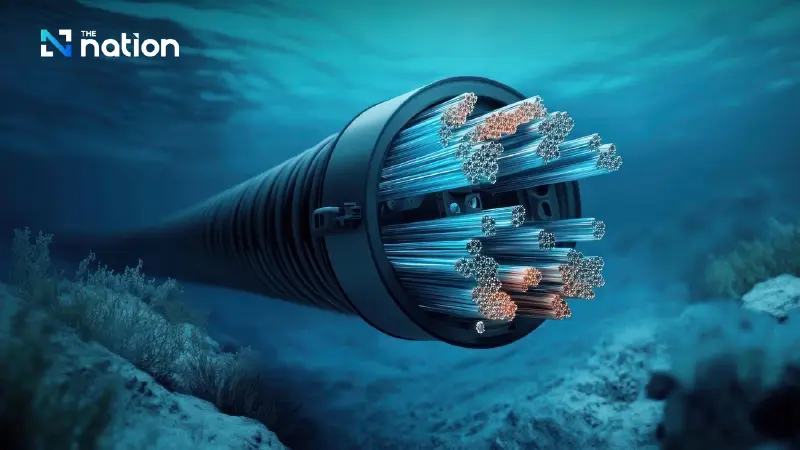


The DE Ministry is pushing state-owned NT to control communication networks as data traffic heavily relies on vulnerable land-based border routes
- Thailand is pursuing "submarine cable sovereignty" to mitigate geopolitical risks, as 80% of its international internet traffic currently relies on vulnerable land-based routes that could be severed during regional conflicts.
- The government is positioning the state-owned National Telecom (NT) to lead this strategic shift by consolidating state networks and investing in new submarine infrastructure to safeguard national security.
- A key part of the strategy is the launch of the Asia Direct Cable (ADC), a new international submarine network connecting Thailand with major IT hubs across Asia to ensure resilient connectivity.
The DE Ministry is pushing state-owned NT to control communication networks as data traffic heavily relies on vulnerable land-based border routes.
Thailand is pivoting away from its heavy reliance on land-based internet infrastructure in a bid to secure "submarine cable sovereignty", warning that regional conflicts and escalating geopolitical tensions could cripple the country's international communications.
Reporting for Krungthep Turakij, journalist Panchat Sinsuk revealed that Bunthida "Nan" Somchai, the Deputy Minister of Digital Economy and Society (DE), announced the strategic shift following a briefing from Col Sanpachai Huvanandana, president of state-owned National Telecom (NT).
The ministry is pushing to restore NT as the backbone of the nation’s digital infrastructure, specifically to safeguard national security and international connectivity.

The Risk of Land-Based Reliance
Currently, Thailand faces what policymakers describe as a severe "geopolitical risk". An astonishing 80 per cent of the country's international internet traffic relies on terrestrial cross-border networks, whilst submarine cables carry a mere 20 per cent.
Because land networks pass through heavily contested or volatile border regions, any outbreak of conflict with neighbouring states could instantly sever Thailand's connection to the global economy.
Furthermore, the 20 per cent buffer provided by underwater routes is dangerously fragile; out of the country's seven or eight existing submarine lines, ongoing damage means only two or three are operating at full capacity.

Why Submarine Cable Sovereignty Matters
Undersea cables are the invisible arteries of the global economy, carrying over 95 per cent of all international data and financial transactions.
In an era where digital connectivity underpins daily commerce, governance, and national defence, "submarine cable sovereignty" is critical.
Achieving it ensures that a nation retains strategic control over its data pathways, preventing foreign adversaries from intercepting sensitive communications, sabotaging physical infrastructure, or cutting off a country from the global internet during times of geopolitical conflict.
While the DE Ministry acknowledges that investing in submarine infrastructure will cost billions of baht, it maintains the expense is essential for long-term cybersecurity.
The ministry also plans to consolidate fragmented landing stations in the southern provinces of Songkhla and Satun—some of which currently encroach on national parks—under tighter state supervision.
Reforming NT for the Digital Age
Though NT cannot compete directly with private mobile operators, the government intends to capitalise on its vast network of property, fibre optics, and state assets. The DE Ministry has ordered NT to draft specific service frameworks for individual public bodies to eliminate national redundancy.

Currently, multiple state enterprises—including the Electricity Generating Authority of Thailand (EGAT), the Provincial Electricity Authority (PEA), and the State Railway of Thailand (SRT)—hold independent licences and build duplicate networks.
The government aims to establish a national policy making NT the sole manager of integrated state networks and rights-of-way.
NT has already presented six high-priority projects to the ministry, including the 1.89 billion baht Phase 1 of the Public Safety Mobile Network (PSMN) 4G/LTE project, which is currently awaiting 850 MHz frequency approval from the National Broadcasting and Telecommunications Commission (NBTC).
Regional Expansion via the ADC Network
As part of its broader digital strategy, NT has officially launched the Asia Direct Cable (ADC) international submarine network. Spanning over 9,988 kilometres, the state-of-the-art cable links critical IT hubs across Asia, including China (Hong Kong and Guangdong), Japan, the Philippines, Singapore, Vietnam, and Thailand.
Designed to support the next generation of high-capacity technologies driving the global economy—such as 5G, Artificial Intelligence (AI), cloud computing, and big data—the ADC network is expected to position Thailand as a resilient regional hub for the expanding digital industry.
