
Thailand's mega project 'Land Bridge' comes at environmental cost
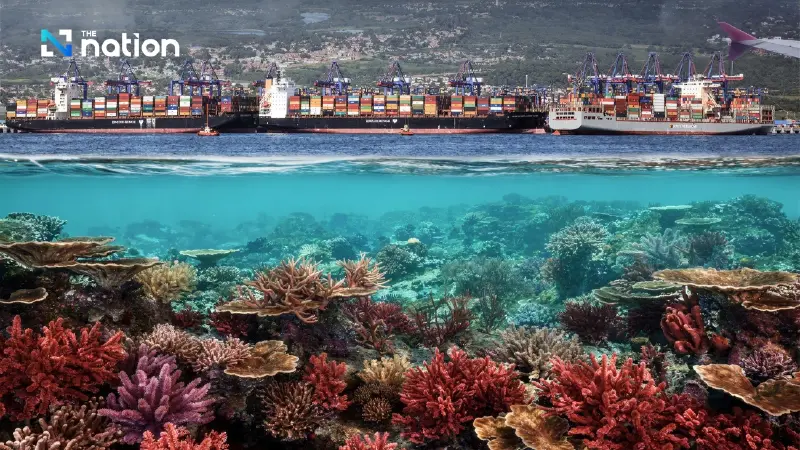


As Thailand pushes forward with its Land Bridge mega-project, critics question whether economic growth will come at the expense of nature and coastal communities.
Thailand’s trillion-baht Land Bridge project may put environments at risk, as one conservation scientist calls the mega-project a “trade-off” between economic growth and environmental protection.
Dr. Petch Manopawitr, a scientist and technical advisor to international organisations, criticised that the mega-project represents a sacrifice of natural resources for economic growth.
“I think a project like Land Bridge brings us to the question of trade-offs again. We have to destroy this capital in order to develop,” he said.
Marine ecosystems and nature reserves in the southern part of Thailand now are listed on UNESCO’s World Heritage Tentative List, but the environment is at stake.

Thailand’s Land Bridge is a mega-logistics corridor linking the Andaman Sea and the Gulf of Thailand through southern Thailand connected by a 90-kilometer transport line with roads, rail, and pipelines.
The trillion-baht mega project has been promoted by the government as a major opportunity to strengthen the country’s role in global logistics hub and trade from China, India, and Western powers.
The government claims that over 280,000 jobs will be offered and the annual GDP will grow to 5.5 %, boosting the southern GDP growth from 2% to 10% for at least 10 years.
The economic benefits may come with serious consequences.
Connecting two opposite sides of the country could damage forests, mountains, mangroves, and marine ecosystems in Ranong and Chumphon, provinces that are home to some of the world’s richest biodiversity, according to Dr. Petch.
He also warns that increased industrial activity and shipping traffic could damage these ecosystems, adding that marine ecosystems in the Andaman Sea are closely connected, meaning environmental damage in one area could spread across the wider region.
“From the shore to the underwater pinnacle offshore to the offshore islands like Surin island and Similan island, all are connected..
“If you are going to have a major impact in one of the areas, it’s going to have an impact on the whole ecosystem because the area is much more connected than what you see,” he noted.
Richelieu Rock, a globally known dive site in the Andaman Sea famous for its rich marine biodiversity, is also facing risks, warned by Dr. Petch, emphasising that the underwater formation creates nutrient-rich currents that attract many marine species and is located relatively close to the proposed Ranong side of the project.

No major developments on high ecological areas - Dr. Petch
The conservationist also argued that industrial development in ecologically sensitive areas goes against the principles of the Convention on Biological Diversity (CBD), an international agreement aimed at halting biodiversity loss, of which Thailand is a member.
“This is a very common issue when it comes to conservation versus development. Actually, on behalf of the government, they should know about all these commitments that Thailand, as a country, has already committed to in multiple international agreements,” he said.
According to Dr. Petch, highly biodiverse and environmentally sensitive areas should not host major industrial developments, arguing that the country no longer needed to choose between economic development and environmental protection, saying development projects should work together with nature rather than damage it.
People’s ways of life at risk
Concerns are not limited to the environment alone, as advocacy groups say local communities could also face major changes to their way of life.
Apisak Tassanee, a representative from environmental NGO Beach for Life, said coastal communities, especially the Moken people who depend on the Andaman Sea, may be affected by the project.

He also questioned whether local residents fully understand the possible impacts.
A recent NIDA Poll showed that more than 67% of southern residents surveyed supported the proposed Land Bridge project. But Apisak questioned whether many people may only have heard about the economic promises while receiving limited information about the social and environmental costs.
“The government only talks about investment, income, and job creation. But it does not explain clearly how communities in the area will be affected or how their way of life may have to change. Once people fully understand the impacts, most of them do not agree with the project,” Apisak pointed out.
Following criticism from environmental groups and the public, the government said it would review the project and reassess possible environmental impacts within 90 days.
Still, Apisak questioned whether the process has genuinely slowed down, noting that development activities appear to continue while the studies are still being reviewed.
For decades, Thailand has searched for ways to improve its role in global trade and regional transport. Supporters believe the Land Bridge could become a major economic opportunity for the country.
But critics say the project has now become a test of how Thailand balances development with environmental protection.
As debate over the Land Bridge continues, the critical question remains whether Thailand can pursue economic growth without placing some of its most important natural ecosystems and coastal communities at risk.
