
Offer incentives to draw SMEs into formal tax system: FTI


Play
Special rates needed to draw majority out of the shadow
The Federation of Thai Industries yesterday urged the government to offer attractive concessions to help bring small and medium-sized enterprises out from “underground” and into the formal tax system.
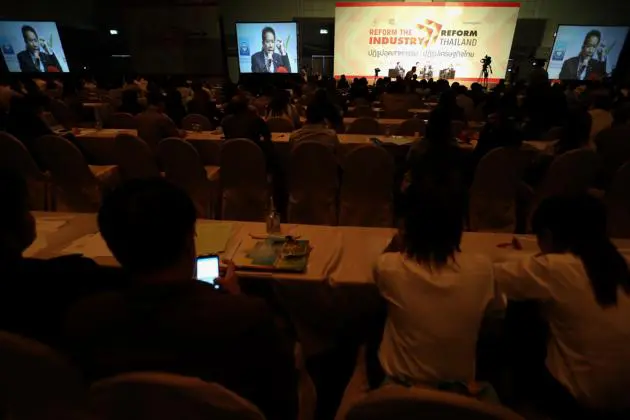
FTI chairman Supant Mongkolsuthree told a seminar called “Reform Industry: Reform Thailand” held by Krungthep Turakit and the Office of Industrial Economics that of the country’s 2.7 million SMEs, only 600,000 were registered and only about 300,000 paid any taxes. If the government wants to change this, it needs to offer special tax rates to lure these businesses to register in the formal system.
“As a former SME [operator] myself, I propose that SMEs must come up ‘above the ground’. Now they are hiding from everything, including taxes,” he said.
The government could offer SMEs an income-tax rate of 5-10 per cent, compared with the current 20-per-cent corporate rate. In return, it would gain extra income from value-added tax as SMEs join the official tax system, said the FTI chief.
Supant said he was glad Prime Minister General Prayut Chan-o-cha had included SME promotion on his regime’s national agenda, since a strong SME sector would help pull up the economy.
SMEs’ contribution to gross domestic product has fallen to 37 per cent from a high of more than 40 per cent in the past.
Meanwhile, in his keynote speech to the seminar, Industry Minister Chakramon Phasukavanich said Thailand’s industrial sector, thanks to its past successes, was still No 1 in Asean, but it was losing its glamour in the eyes of foreign investors.
“We’re no longer the darling of investors. If this were a beauty pageant, [we’d look] pretty old,” he said.
Chakramon said the falling fortunes of Thai industries was due to a changing industrial era, development of other economies that sprang up as competitive destinations for foreign direct investment, and the strategy of foreign investors to diversify risk.
Nevertheless, the minister said he expected the Thai manufacturing sector to grow by 6 per cent next year, thanks partly to improved exports, the government’s efforts, and the full implementation of the Asean Economic Community at the end of the year.
“Next year, some people say we’ll see a ‘real funeral’, because foreign economies will still not have recovered. But at least the falling oil prices and slight growth of [domestic] purchasing power will help. And I believe the government will be able to get rid of all obstacles before the end of this year,” he said.
Chakramon said many of the problems faced by Thai industries would be solved as many laws are being amended in the National Legislative Assembly and the government is going to invest in several infrastructure projects, such as railway double-tracking and expanding the Laem Chabang deep seaport.
“However, there are still some problems such as customs and port [procedures] that cannot be solved by amending regulations alone,” he said.
Chakramon said some Thai industries, such as those based on agriculture and automobiles, were doing well, but the chemical industry needed to find appropriate areas to absorb its future expansion. The government also needs to tackle the problem of hazardous waste, which will become a big issue within 10 years if there is no proper management.
Atchaka Sriboonruang, permanent secretary of the Industry Ministry, said that to assist SMEs, the government needed to prioritise which business groups it should help.
