
Investment in Asean infrastructure seen as crucial role for both private and public sectors


Play
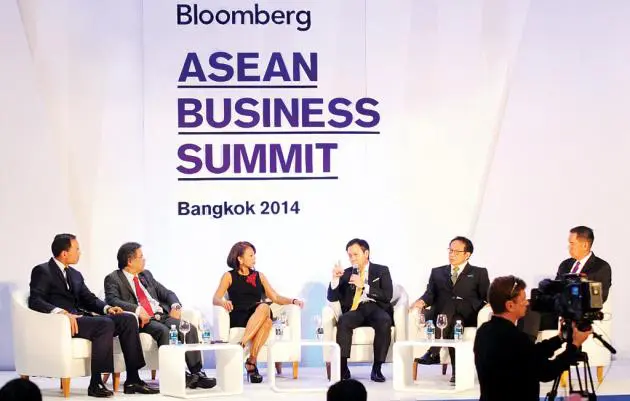
Asean's public and private sectors agree that the first and foremost priority in the preparation for a more fully integrated region and the Asean Economic Community (AEC) next year is investment in infrastructure.
They believe that both private companies and member governments have a role to play in the development of the region.
Speaking at the “Bloomberg Asean Business Summit” in Bangkok yesterday, Gita Wirjawan, a former trade minister of Indonesia, said the assumption that the current US$2.4-trillion (Bt79 trillion) collective gross domestic product of Asean would reach between $3.5 trillion and $4 trillion in the years to come was “purely assuming linearity, which sometimes makes us forget the fact that infrastructure development spending must be there to support the expected growth”.
“We are talking about 5 to 6 to 7 trillion US dollars that is needed for infrastructure spending. Where is that money going to come from? It is not going to just all come from the private sector, even though they are going to playing a big part, and it is not going to be able to jump to the level that we want it to be without any fiscal game-changing,” he said.
Dr Francis Yeoh, managing director of the YTL Group in Malaysia, said business and investment required a stable regulatory framework and rule of law to thrive, and there was a serious inconsistency of this aspect in Southeast Asia.
The potential and opportunities of the AEC will not be realised and exploited unless the governments can provide a transparent coherent regulatory framework for infrastructure to investors, he said.
“Is there a lack of capital in Southeast Asia? Absolutely not. Is there a lack of expertise? Absolutely not. But there is actually a lack of vision. The solution [for infrastructure investment in the region] is simple, and that is a transparent regulatory framework, since a regulatory framework would allow people like me to invest,” he said.
“Governments [in the region] should ensure that their rule of law is transparently debatable … and a coherent framework means that you do not change your mind half way on investment in infrastructure,” he added.
‘Think beyond own shores’
Senator Idris Jala, minister in Malaysia’s Prime Minister’s Department and chief executive officer of the Performance Management and Delivery Unit (Pemandu), said leaders in the Asean business community should wake up to the fact that they have to think beyond their own shores in order to prepare for the AEC, and that the role of government is simple – and that is to govern.
Korn Chatikavanij, former Thai finance minister, said the Kingdom needed investment in infrastructure in order to expand, which required a large amount of capital.
He agreed with the current minister of finance, Sommai Phasee, that the government still had room to increase its budget deficit. The country can borrow more to support much-needed investment, but transparency and stability in the rule of law and the nation’s economic structures are a prerequisite condition for getting such loans, he added.
“The introduction of inheritance and land and construction taxes, along with the increase in value-added tax by the end of next year, would not provide that much income for the government. The most effective [result] in terms of increasing income would be from the increase in VAT, since an increase of 1 percentage point would provide an [additional] income of around Bt60 billion to Bt70 billion.
“That is still insignificant when compared with the current government income of around Bt2 trillion, but it is better than nothing for the government,” he said.
Siam Cement Group chief executive Kan Trakulhoon said he did not see any “bad news” for Asean, except for Thailand, for which he hoped all the bad news was behind us.
After having to revise cement-demand forecasts three times last year – the most frequent changes in his conglomerate’s century-old history – Kan said SCG now expected the Kingdom’s cement demand to return to positive year-on-year growth of 6 per cent in 2015.
“Cement is a good leading indicator [of the economy] ... I would say all the bad news [has] gone,” he said.
Nevertheless, Kan said he did not think Thailand’s GDP could expand by 4-5 per cent next year as targeted by the government, since it would take time for domestic consumption to recover.
“We have to see the next one to one and a half months. It takes some time to translate [government] plans into execution and consumption,” he said.
Kan also declined to say whether Thailand had fully restored its stability. “It’s peaceful … [which] means no demonstrations or violence,” he said. The SCG chief reaffirmed his positive view on Asean, especially for Indonesia, Vietnam and other countries in Indochina.
