
Prayut urges 4G spectrum auctions as soon as possible


Play
Prime Minister General Prayut Chan-o-cha said yesterday that he supported the plan to auction spectrum licences as soon as possible next year for fourth-generation cellular service, as well the establishment of a national broadband network and a national
He made the remark during a seminar on the “digital economy” hosted by Post Today newspaper.
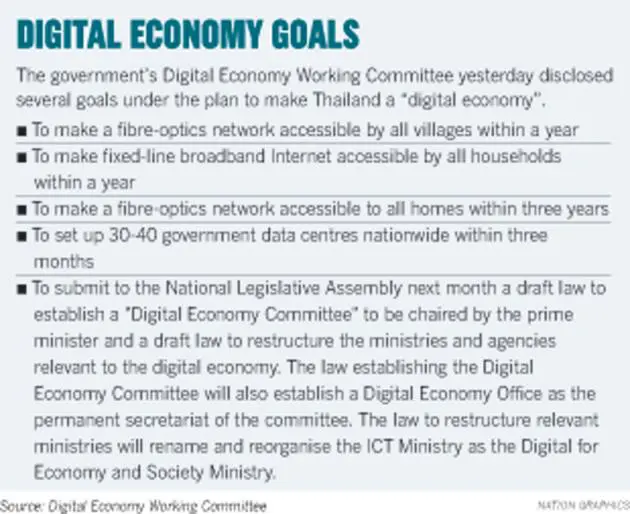
Deputy Prime Minister MR Pridiyathorn Devakula announced at the same seminar the government’s goals for the digital economy, which is aimed at boosting the country’s competitiveness.
Prayut said the government would promote the utilisation of digital technology in all aspects and all sectors in order to accelerate economic growth. The elderly and disabled would also benefit from the digital economy, he claimed.
The National Broadcasting and Telecommunications Commission (NBTC) had planned to hold auctions for new spectrum licences this year but the junta ordered a suspension, pending its complete clarification of the plan with the junta.
Since then, private mobile-phone operators have urged the government to make these auctions happen as soon as possible to enable them to use the spectra to enhance their 4G wireless broadband service.
Information and Communications Technology Minister Pornchai Rujiprapa said legislation was needed to establish a “Digital Economy Committee”, chaired by Prayut. This Digital Economy for Economy and Social Act is expected to be submitted for the National Legislative Assembly (NLA) next month.
A Digital Economy Office will function as the permanent secretariat for the Digital Economy Committee.
The Digital Economy Committee will have five subcommittees to oversee hard infrastructure, soft infrastructure, service infrastructure, digital-economy promotion, and a digital society, including knowledge resources. Pornchai said all existing fibre-optic networks would have to be integrated.
Kosol Petchsuwan, a member of the working committee, said that according to the NBTC, the fibre-optic networks of 16 licensed companies covered about 500,000 square kilometres, and their combined length was 200,000 kilometres. Currently, each of them uses only 10 per cent of capacity on average.
Pornchai said a National Information Centre would be needed to coordinate statistical information and to establish a National Data Centre.
Next year, the ICT Ministry plans to spend Bt3.7 billion on four main schemes to support the digital-economy plan. They are an ICT system for schools in border areas (Bt95 million); an enterprise resource planning cloud for small and medium-sized enterprises (Bt940 million); a national API (application programming interface) platform to encourage the innovation development (Bt144 million); and a system for hosting surveillance-camera information (Bt70 million).
Pornchai said two draft laws would be submitted to the NLA next month, one to set up the Digital Economy Committee and the other to restructure and rename relevant ministries. Another six draft laws will be submitted later.
Djitt Laowattana, another member of the working committee, said the government data centres could be established within three months. These would require about 80,000 racks of servers to run 30-40 data centres of 2,000 square metres each in different parts of the country. This would require about Bt30 billion.
“The three priority sectors that will immediately benefit from the digital economy plan are the financial and capital market sector; the manufacturing sector; and the education sector,” he said.
