
Bangkok's planned 'Sky Ride'


Play
Bangkok's proposed "Sky Ride" is a good model addressing urban problems in the future, a seminar in Bangkok was told yesterday.
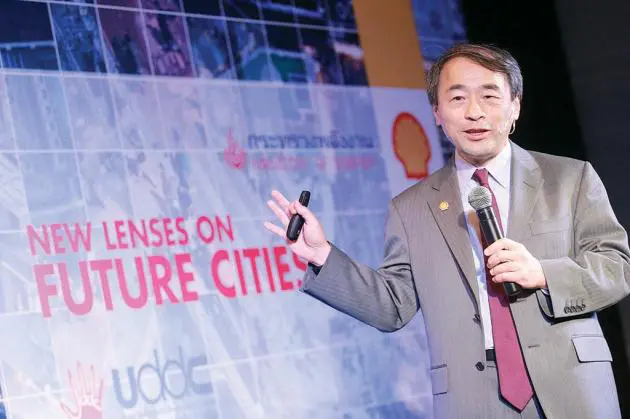
The Shell Thailand-hosted event, which discussed details of a Shell Global report titled “New Lenses on Future Cities”, looked at how cities around the world have been using energy in order to get a better understanding of the impact of the growth of global cities, including Bangkok.
Jon Sealy, design director at London-based design company Marques & Jordy, cited as a good alternative the proposed 55-kilometre “Sky Ride”, an “ecosystem elevated highway that will run along the BTS as a carbon-zero project”.
He said the planned cycling path promoted both greenery and a healthy lifestyle as it encouraged people to use bicycles for travel.
The project would help ease traffic jams in a future where, as the report stated, around 70 per cent of the world’s population is expected to be living in cities.
“This increase in population will create stress on resources [by] 2030,” according to United Nations data.
“And our scenario results in a 40 to 50 per cent dependency increase on resources,” said Asada Harinsuit, chairman of The Shell Company of Thailand.
Dr Cho-Oon Khong, chief political analyst of Shell International, likened the situation to creating “one new Bangkok every five weeks” around the world.
Given this scenario, Khong said cities would consume up to 80 per cent of the world’s total energy over the next three decades. Urbanisation and energy demand would then have direct effects on quality of life.
Khong said it was important to “find how decision-making processes impact on the way of lives of people in the cities, including energy resources, water resources, and food”.
He identified three key elements in addressing urban growth: planning, pollution and people.
“The key also is to fill in city spaces rather than expanding the city,” he said.
Given population growth would likely cause more energy consumption and worsen pollution, he stressed that government policies should encourage the use of green and clean energy.
He emphasised the need to reduce carbon emissions by providing alternatives and improving public transport to encourage people to use it.
He said this would help reduce traffic and pollution as well as save energy.
Dr Niramon Kulsrisombat, UDDC director, called for stronger policies to restore inner cities.
“We don’t have many platforms to engage stakeholders,” she said. “We have been unsuccessful because of the lack of agencies to help address inner city growth.”
She pointed out that Bangkok needed better planning, citing Hong Kong, Europe and Japan’s efficient use of space while providing pedestrian-friendly areas.
She said 18 per cent of private-sector land in Thailand was underused and there was a need to “discuss how we can restore it”.
