
Analysts call for sustainable ways to help farmers, develop rice industry


Play
Subsidies do nothing for long-term change, critics charge
“Give a man a fish, you will feed him for a day. Teach a man to fish, you will feed him for a lifetime.” This ancient proverb is certainly true and clearly reflects the failure of the Thai governments’ rice-subsidy projects to help farmers for a decade, critics claim.
Rice subsidies, whether the governments that implement them call them “pledging programmes” or “income guarantees”, have never led to sustainable development, they charge. Instead, such schemes have caused huge financial burdens for the Kingdom and only improved farmers’ incomes for short periods.
Thailand has spent between Bt40 billion and Bt80 billion per annum on rice subsidies during the past decade. Worse, a study by the Thailand Research and Development Institute (TDRI) suggested that spending on rice subsidies during the past two years would amount to as much as Bt750 billion.
Unfortunately, that money rarely goes towards improving the efficiency of rice farming or its supply-chain industries. Politicians have only created short-term measures to satisfy farmers for a short time.
This year, after seizing power from the elected government with the claim that it would stop playing this game, the military regime fell into a similar trap – albeit only for the short term, the junta insists – of directly paying farmers Bt1,000 per rai, for a maximum of 15 rai (2.4 hectares) each.
To ensure the rice price does not drop precipitously, the government has also budgeted for soft loans to millers and rice farmers, so that they do not need to accelerate rice sales during the harvest season.
But despite these populist measures, the market price of Thai rice is still low, under pressure from the enormous stockpiles in the government’s warehouses. Farmers have still not been able to build rice barns and therefore cannot hold their produce for too long as its quality would deteriorate.
Given these factors, it appears this is the right time for the government and the private sector to launch a long-term development plan for the rice industry.
Aat Pisanwanich, director of the International Trade Studies Centre of the University of the Thai Chamber of Commerce, said that with upcoming Asean seamless trade, sustainable long-term measures should be implemented to encourage Thai farmers to focus on quality rice production rather than only on price or relying on government support.
“It is time to educate farmers to rely more on themselves by teaching them to develop rice quality, while the government can provide other support to facilitate rice production and marketing, and help develop the supply chain,” Aat said.
Thai farmers must urgently improve productivity to ensure their competitiveness in the seamless market, he said. They must also decrease the cost of production and logistics, and diversify from commodities to high-value-added goods. The government should draw up a strategy to strengthen agricultural practices – one that not only promotes higher prices via intervention schemes, but also improvement in productivity.
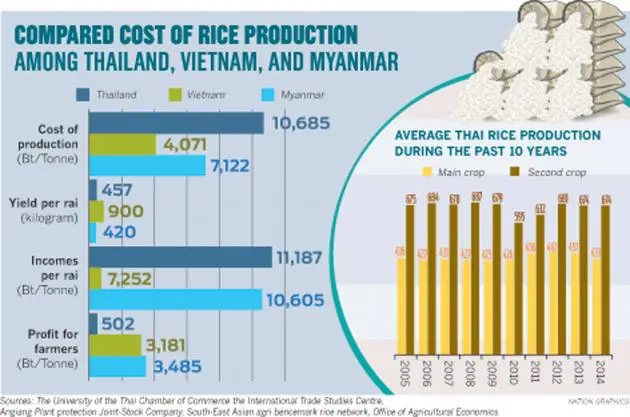
Aat claimed Thailand’s rice productivity was almost the lowest among Asean countries, while Thai farmers get the smallest incomes. For example, in this year’s crop, the rice yield per rai is 457 kilograms in Thailand, 900kg in Vietnam, and 400kg in Myanmar. The cost of Thai rice production is Bt10,685 per rai, for Vietnam Bt4,071, and Myanmar Bt7,122, while income per rai for Thai farmers is Bt11,187, for Vietnamese Bt7,252, and Myanmar farmers Bt10,605. As a result, Thai farmers see only Bt502 per rai as profit, while Vietnamese farmers have Bt3,181 left, and Myanmar’s get Bt3,485 per rai.
Somkiat Tangkitvanich, president of the TDRI, claimed the rice-pledging project had cost the Kingdom huge amounts of taxpayers’ money, while it was not able to help farmers long-term. He said it was time that the government, private enterprise, farmers, and all involved created measures to help farmers in a more sustainable way rather than only handing out money.
Long-term rice strategy development
In fact, the military regime does have a “rice strategy”, but it has not yet been implemented in any tangible measure.
Boonyarit Kalayanamit, director-general of the Commerce Ministry’s Internal Trade Department, said the rice strategy was aimed at improving the production, marketing and quality of Thai rice, while somehow improving farmers’ lives without intervening in the “market mechanism”.
The strategy is meant to solve long-term problems from the production stage to marketing. The government will set up rice-plantation zones while also encouraging farmers to grow other economic crops on land that is not suitable for rice.
Those strategies include creating fairness in rice trading, enhancing rice standards and the trading system, encouraging more rice consumption, increasing production efficiency, encouraging innovation in the rice industry, and developing the logistics system for rice.
Those measures sound nice, but they need implementation. The government needs to invest in these sustainable measures and encourage more farmers to be concerned with long-term development rather than short-term income.
Pramoth Vanichanont, former president of the Thai Rice Millers Association, said all involved sectors, including government, academia, farmers and traders should forge closer ties to develop the rice industry.
First, rice traders and farmers should focus on the upper-end market, because it has higher returns.
Of the global population, 20-30 per cent are classified as “upper class”, and this group is expected to get larger in the next five years. This segment has high purchasing power and prefers high-quality products. Thailand, with its jasmine rice and other premium grades including Geographic Indication and high-nutrition rice such as “Riceberry” and “Seenil”, must produce more of these types to serve this market.
At present, Vietnam can export up to 7 million tonnes of rice a year and Cambodia 2 million tonnes, while Myanmar is expected to increase its annual rice exports to 1.5 million tonnes. Most of this is lower-value white rice. Thailand must focus more on higher-quality rice, especially fragrant and high-nutrition grains, so that we can beat our rivals, he said.
Second, Thailand must develop better breeding techniques and increase yield per rai. The country has spent more than 30 years developing its long-grain rice. Pramoth said development time for quality strains must be shorted from between seven and 12 years to only three years, while increasing yield per rai, in order to serve higher demand in Asean and other markets.
Moreover, the government needs to invest more on research and development. The Vietnamese government has invested more than Bt4 billion in rice development over the past five years, while Thai rice farming has received only Bt100 million to Bt200 million a year for that purpose. To achieve the goal of maintaining Thailand’s position as the world’s biggest rice exporter and leader in rice-farming development, the government must place development of the crop on the national agenda, he said.
It should allocate about Bt20 billion a year to develop better breeding techniques, increase yields, and develop an irrigation system.
At present, only 28 per cent of the 64 million rai devoted to growing rice is irrigated. Also, the government needs to support infrastructure development along the rice-industry supply chain. It should encourage farmers in cooperatives to build their own warehouses and concentrate on logistics.
Prasith Boonchuey, president of the Thai Rice Farmers Association, claimed most farmers realised that they need long-term development and not just government handouts.
Thailand has spent huge amounts each year to shore up rice prices, but less on development than other countries. Nobody is against measures to help poor farmers improve their standards of living, but Prasith said the association acknowledged that subsidies were not sustainable. Now is a suitable period for the government to spend less on price intervention and focus on sustainable development to educate farmers and help them become self-reliant for the future.
