
Delay in oil bid 'a setback'


Play
DELAYING THE 21st round of bidding for petroleum concessions would negatively affect investor confidence, a senior energy official said yesterday.
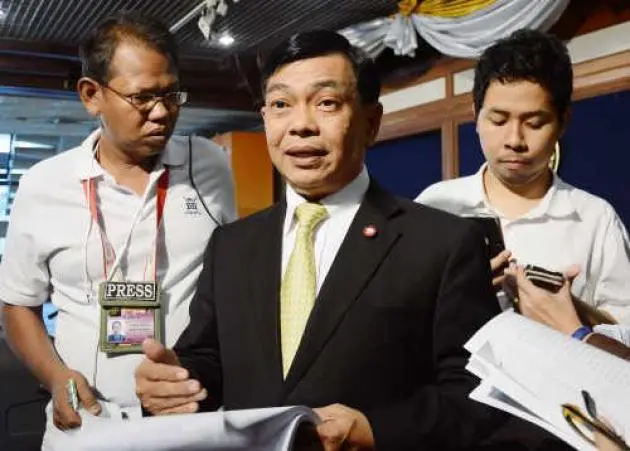
Kurujit Nakornthap, deputy permanent secretary of the Energy Ministry and a member of the energy reform committee of the National Reform Council (NRC), said the decision on whether Thailand should go ahead with the bidding now lay with the government and the Energy Ministry. “The committee’s task has been completed. We undertook the study [on whether and/or how to commence the concession bidding] because the government had asked us for our opinion,” he said.
A majority of NRC members on Tuesday disagreed with the energy reform committee’s resolution to move ahead with the 21st bidding round in accordance with the present plan and to study a production-sharing system that is suited to the potential of the petroleum resources.
“There are 25 members of the energy reform committee, 22 of whom agreed with the opening of the 21st petroleum concession round, while three members reserved their opinion,” he said.
The three minority members were Alongkorn Polaboot, Charnarong Yaowalert and Rosana Tositrakul.
Kurujit said that during the NRC’s general deliberation session, most speakers had expressed support for the 21st round.
However, since the subsequent vote on the issue had come down on the other side, it is now up to the government to make a decision as to whether to follow the rationale of the majority of the committee members or the majority vote by the NRC, he said. A delay in the bidding round would negatively affect investor confidence, since the government had already announced that it would open the new round, he stressed.
Kurujit said the country had to import more than Bt1 trillion worth of energy sources a year, with crude oil accounting for 85 per cent of the imports and natural gas for the remainder.
Meanwhile, the power sector has to depend on natural gas for 70 per cent of its electricity generation, a figure that is increasing in contrast to the country’s natural-gas reserves, which are declining.
Therefore, if the country cannot find additional reserves, it could face an energy crisis and waste money on importing other types of fuel, factors that would widely affect the economic and social systems, he said.
Deputy Prime Minister Wissanu Krea-ngam said he had an appointment with the NRC and 18 reform committee members today, at which he would discuss a wide array of topics, including whether there was any problem with the NRC’s coordination with the government.
Under the interim constitution, the NRC can make a recommendation to the government, which will then consider whether or not to follow it, he added.
Alongkorn Polaboot, an NRC member and whip, said the reform council would submit the report about its voting on the petroleum-concession bid to Prime Minister General Prayut Chan-o-cha by the end of this week, as well as two other reports – one from the energy reform committee and the other from the committee on public participation and hearing of public opinion.
He said the government could choose high-potential fields such as the four offshore blocks adjacent to the Erawan and Bangkok fields in the Gulf of Thailand to undertake a production-sharing system, because the fields were currently run by Chevron and PTT Exploration and Production respectively.
