
Asean-5 not immune to global volatility


Play
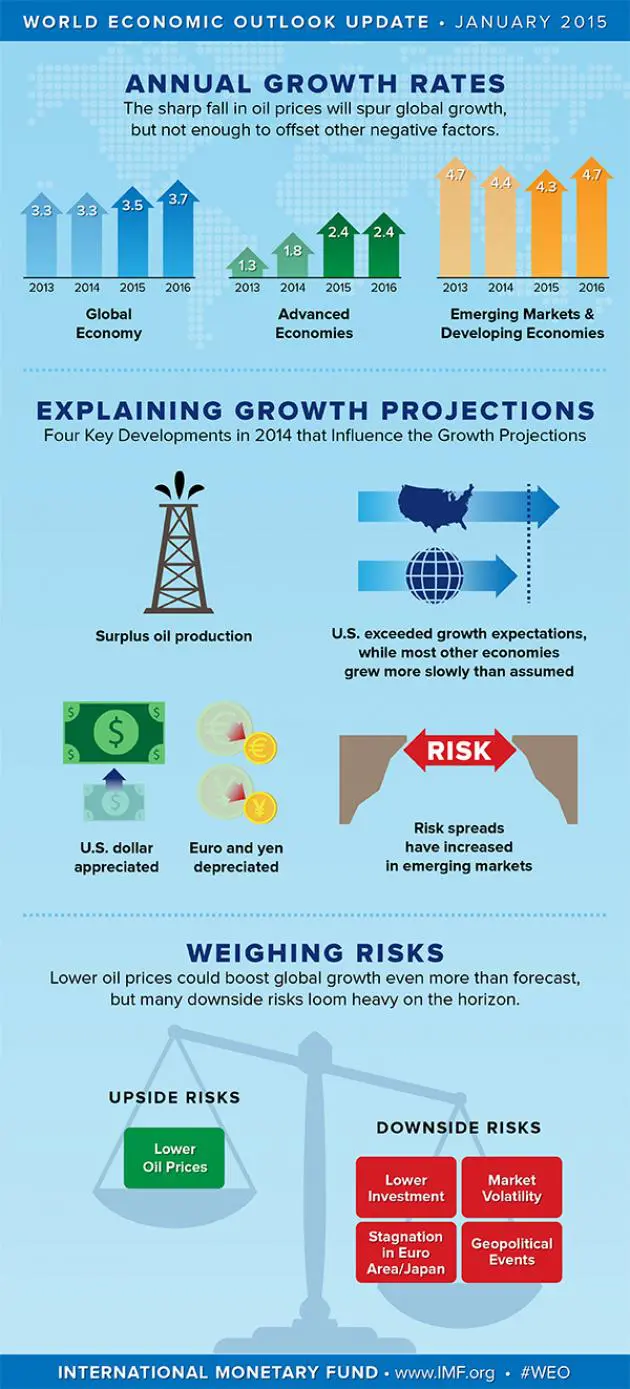
The International Monetary Fund has revised down its global growth forecasts for 2015 and 2016 by 0.3 per cent to 3.5 and 3.7 per cent, taking into account slowdown in several countries as well as falling oil price.
The World Economic Outlook (WEO), released today, attributed the revisions to a reassessment of prospects in China, Russia, the euro area, and Japan as well as weaker activity in some major oil exporters because of the sharp drop in oil prices. The United States is the only major economy for which growth projections have been raised by 0.5 and 0.3 per cent to 3.6 and 3.3 per cent in the years, from 2.4 per cent in 2014.
China's growth forecast is chopped by 0.3 and 0.5 per cent, to 6.8 per cent and 6.3 per cent - the lowest in the past two decades.
In this scenario, Asean-5, consisting of Indonesia, Malaysia, Philippines, Thailand, Vietnam is expected to show growth of 5.2 per cent in 2015 and 5.3 per cent in 2016, down by 0.2 and 0.1 per cent from previous forecast in October. In 2014, the region's growth rate was 4.5 per cent.
"Global growth will receive a boost from lower oil prices, which reflect to an important extent higher supply. But this boost is projected to be more than offset by negative factors, including investment weakness as adjustment to diminished expectations about medium-term growth continues in many advanced and emerging market economies," according to WEO.
Developments since the release of the October WEO have conflicting implications for the growth forecasts.
On the upside, the decline in oil prices driven by supply factors - which, as noted, are expected to reverse only gradually and partially - will boost global growth over the next two years or so by lifting purchasing power and private demand in oil importers. The impact is forecast to be stronger in advanced economy oil importers, where the pass-through to end-user prices is expected to be higher than in emerging market and developing oil importers. In the latter, more of the windfall gains from lower prices are assumed to accrue to governments (for example, in the form of lower energy subsidies), where they may be used to shore up public finances.
However, the boost from lower oil prices is expected to be more than offset by an adjustment to lower medium-term growth in most major economies other than the United States.
In emerging market and developing economies, growth is projected to remain broadly stable at 4.3 per cent in 2015 and to increase to 4.7 per cent in 2016 - a weaker pace than forecast in October.
Looking forward, the IMF foresees escalating risks. In global financial markets, risks related to shifts in markets and bouts of volatility are still elevated. Potential triggers could be surprises in activity in major economies or surprises in the path of monetary policy normalisation in the United States in the context of a continued uneven global expansion. Emerging market economies are particularly exposed, as they could face a reversal in capital flows.
With the sharp fall in oil prices, these risks have risen in oil exporters, where external and balance sheet vulnerabilities have increased, while oil importers have gained buffers. In the euro area, inflation has declined further, and adverse shocks - domestic or external - could lead to persistently lower inflation or price declines, as monetary policy remains slow to respond. In many major economies, there are still some downside risks to prospective potential output, which would feed into near-term demand.
Geopolitical risks are expected to remain high, although related risks of global oil market disruptions have been downgraded in view of ample net flow supply.
