
MUFG believes synergy will boost mutual prosperity
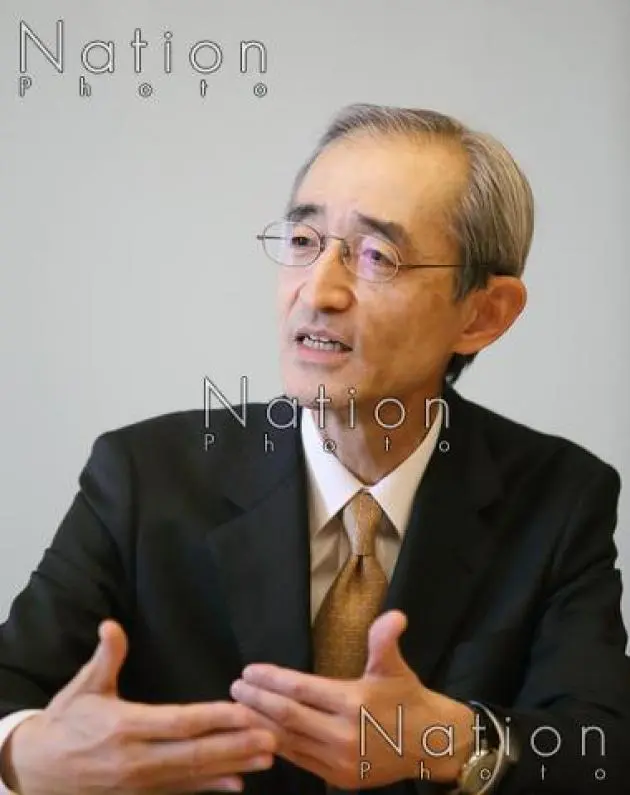


By size, Bank of Tokyo-Mitsubishi UFJ is the world's sixth-largest lender, while Bank of Ayudhya (Krungsri) is the fifth-largest lender in Thailand. Despite the difference in sheer size, the Japanese bank's top executive believes the synergy that inspir
"We can work together," Nobuyuki Hirano, president and chief executive of Mitsubishi UFJ Financial Group (MUFG) and president of Bank of Tokyo-Mitsubishi UFJ, said in an interview. "All Japanese corporations are committed to this country. We’re committed to be here for not years but decades, 50-100 years."
It affirmed that commitment at a party last week where chiefs of BTMU regional offices gathered in Bangkok to celebrate the successful integration.
Krungsri is apparently a key part of the Japanese bank’s drive to grow business outside its own country, which generates one-third of total revenue. The Thai bank last year contributed 26 per cent of the group’s operating profit, while 26 per cent came from the rest of Asia, 28 per cent from the United States, and the rest from other places.
Hirano also praised the Thai bank’s founders, the Ratanarak family, for establishing a solid business. For that reason, MUFG has no plan to buy more shares in the Thai bank on top of the 72-per-cent stake it already owns, he said.
MUFG’s takeover in 2013, valued at US$5.17 billion (Bt167 billion), was the largest banking takeover in Thailand and also the largest Asian acquisition by a Japanese bank.
Hirano foresees the seamless services underpinned by Krungsri’s success stories in Thailand and BTMU’s global network that could be offered to Japanese and Thai businesses seeking to expand in Southeast Asia and elsewhere as well as individual consumers across the region.
Asean strategy
The strategy "to grow with Japanese companies" runs well with the trend that Japan seeks to grow its investment in Asean, which plans to create a single economic community by year-end. Hirano believes Japanese companies’ presence in the region is solid, particularly in the automotive industry, thanks to a more extensive supply chain than in other parts of the world.
Despite crises in Japan and in this region, Japanese investment has remained strong.
"With the AEC [Asean Economic Community], Thailand represents great opportunities for us. Thailand is the centre of continental Asean. We’d like to build business in and outside this country."
Hirano foresees the huge potential of synergies to come from the integration of Krungsri, which is designed to play a bigger role in other Asean countries outside Singapore and Jakarta. This would be assisted by the unified banking rules under the AEC that should come sooner or later.
In the near future, the Thai bank’s credit-card holders will be offered special privileges when spending in Japan. New services will also be offered to Thais employed by Japanese companies, who currently number about 700,000.
Meanwhile, he foresees the possible export of Krungsri’s business models in growing consumer-loan areas – auto and personal loans – to other countries like Vietnam and Myanmar.
As Japan shows strength in small and medium-sized enterprises through technology and innovation, this experience can be shared with Asean countries.
As the world’s No 1 in project financing, BTMU also aims to get a slice in Asia’s infrastructure investment spree. According to the Asian Development Bank, infrastructure-investment needs in Asia could reach $750 billion annually during the 2010-2020 period.
With a greater flow of people and investment, Hirano sees possible growth in transactional banking as well as asset-management business.
BTMU is still looking for more merger and acquisition opportunities, particularly in Southeast and South Asia. Hirano acknowledged that a bigger scale could introduce greater risks, but he is certain that with Tier 1 capital at 11 per cent, a proper risk-control environment and its presence in growth markets, the Japanese bank is ready to play a bigger role.
"Amid growing instability, we should see how to detect risks, sometimes geopolitical, before they happen. We have to put our risk antenna high in the sky."
