
NBTC to consider new frequency master plan


Play
THE National Broadcasting and Telecommunications Commission will consider the new frequency master plan on Wednesday, which aims to strengthen national security and facilitate new broadband telecom services in the future.
The Telecom Committee recently approved the plan and will table it with the NBTC, which has the responsibility of revising the plan every other year.
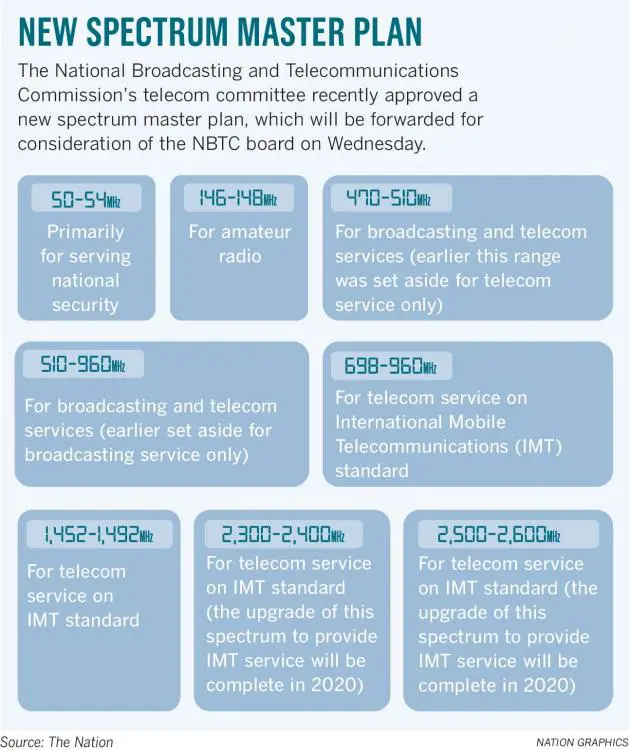
The new master plan sees the reallocation of the 50-54-megahertz range to the Army to enforce national security and solve their reported conflict.
The conflict stems from the watchdog’s allocation of 50-54MHz last year to ham radio operators, who had been using the 144-147MHz band.
The Army, which had been using the 50-54MHz band for emergencies, opposed the move.
However, the watchdog has yet to allow amateur radio operators to use the new band, given the protest by the Army.
The new master plan also reallocates 470-510MHz for both telecom and broadcasting services, instead of only for telecom services, at present.
TOT uses this band to provide its analog cellular service, but the watchdog wants to reclaim it for both telecom and broadcasting services.
In the future, the NBTC will ask terrestrial digital TV stations to switch to broadcasting on the 470-510MHz range from the current 510-790MHz so that the NBTC can reallocate the 510-790MHz range to telecom services.
The watchdog is keen to reclaim the 2500-2600MHz band from MCOT for reallocation to 4G wireless services running on long-term evolution broadband technology.
The NBTC has already asked MCOT to return the spectrum, but the company refused and took the dispute to the Central Administrative Court.
The Telecom Committee also recently approved the combination of currently used 17.5MHz bandwidth of 900MHz with its idle 3MHz bandwidth of the same spectrum.
This means that when it auctions the 900MHz spectrum, there will be 20MHz available instead of only 17.5MHz, which is being used by Advanced Info Service under its concession from TOT, which expires in September.
