
Ad spending unchanged on the digital TV bandwagon
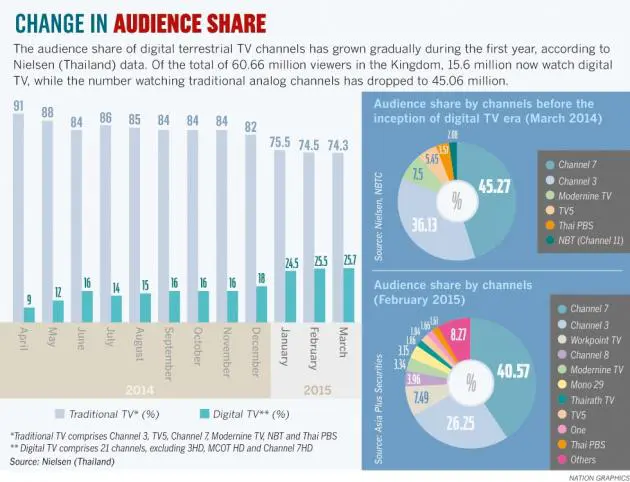


THE BIRTH of digital terrestrial TV last year added more players to the Bt80 billion TV broadcasting industry but advertising spending remained unchanged in the first year. In April last year, Thailand's broadcasting industry began moving to the digital
The competition in the new ecosystem inevitably became fierce as all the players were chasing after the same size audience.
The arrival of the new players seemed to have had little impact on duopoly Channel 7 and Channel 3.
Last month, Nielsen found that Channel 7 ranked No 1 with 1.94 million viewers per minute, followed by Channel 3 with 1.21 million viewers, Workpoint Creative TV with 365,546, Channel 8 with 200,784 and Mono 29 with 157,520.
However, the situation at Modernine TV, run by MCOT, and TV5, operated by the Army, was |otherwise. According to Nielsen, Modernine TV was sixth with 147,561 viewers per minute while TV5 stayed at ninth with 81,888.
Referring to Nielsen (Thailand)’s data, Takorn Tantasith, secretary-general of the National Broadcasting and Telecommunications Com-|mission (NBTC), said last week that the audience share of digital terrestrial TV was gradually growing during the first year.
“Of the 60.66 million viewers in the country, digital TV viewers now reach more than 15.6 million, representing 26 per cent, while traditional TV viewers dropped to 45.06 million, or 74 per cent,” he said.
The penetration of digital TV has not gone unnoticed by advertisers. In the first 11 months of digital TV, ad spending via 21 digital terrestrial TV channels – excluding 3HD, MCOT HD and Channel 7 HD – reached Bt17.42 billion, accounting for 23.4 per cent of the total Bt74.59 billion. The rest of the market went to the six incumbent analog TV stations.
Ong-art Singlumpong, executive vice president of RS Channel 8, said he witnessed a migration of viewers from analog to digital terrestrial TV stations and of budget allocations from the old to new TV channels.
Channel 8 expects to see more income in the near future.
“In the year to come, it is likely that the top 10 broadcasters will enjoy healthy growth while the rest are still facing a tough situation due to fierce competition,” said Chalakorn Panyashom, executive vice president of Workpoint Entertainment, the operator of Workpoint Creative TV.
Surin Krittiyaphonphun, executive vice president of Bangkok Entertainment Company (BEC), said the development of the digital terrestrial TV business did not meet his expectations due to political and economic factors in the past year.
BEC’s sister company BEC-Multimedia runs three digital terrestrial TV channels – 3HD, 3SD and 3Family – but 3HD is being used to simulcast BEC’s Channel 3. With those digital TV operations, BEC-Multimedia has to bear high costs while fighting for audience share in the stagnant market.
Many digital terrestrial TV broadcasters expressed disappointment in the transition from the analog to digital terrestrial era under the NBTC.
They are calling for further assistance from the regulator to deal with rising costs in the early stage of the industry’s development, such as a reduction in licence fees and postponement of the second-round payment of spectrum licence auction fees.
