
Higher costs won't hurt consumers: Egat


Play
THE ELECTRICITY Generating Authority of Thailand insisted yesterday that the launch of the country's first state enterprise infrastructure fund would not make life difficult for electricity consumers, even though it would raise Egat's cost of funds.
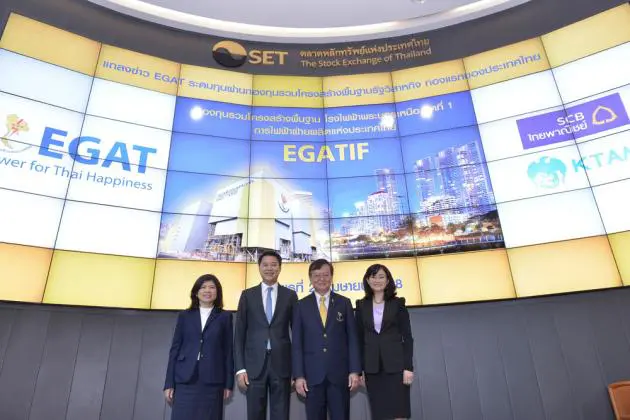
“Because of the public-debt ceiling, we have to accept a higher cost of funds, but [the impact] is negligible on the electricity tariff,” Soonchai Kumnoonsate, governor of Egat, told reporters at the launch of the North Bangkok Power Plant Block 1 Infrastructure Fund, or EGATIF.
EGATIF’s dividend pay-out rate is expected to be higher than 4.75 per cent, which is the average coupon rate on Egat’s bonds.
Egat’s debts are counted as public debts. The government has set a debt limit for state enterprises to follow and encourages them to seek alternative financing such as infrastructure funds.
Egat has no plan to issue more infrastructure funds before 2017, Soonchai said. The first infrastructure fund allows Egat to retain ownership of the North Bangkok Power Plant Block 1’s assets. Only its future income stream is securitised for 20 years.
Investors will receive dividends twice a year that are at least 90 per cent of the power plant’s income from “availability payments”, excluding the operating and maintenance costs that will be shouldered by Egat, and the “energy payments” that fluctuate along with fuel costs.
The availability payment is based on the readiness of a power plant to produce electricity, not necessarily on its actual output. It is a common model for power-plant contracts to include the two-part tariff comprising the availability and energy payments.
The facility is adjacent to Egat’s head office in Nonthaburi, within the Greater Bangkok area, where electricity demand is high. This would give it good prospects for receiving electricity-dispatching orders from the national power grid, Soonchai said.
Egat, which controls the national grid, will usually order electricity from the lowest-cost producers, except to meet the minimum purchase requirements under contracts with private power producers, he added.
North Bangkok Power Plant Block 1 runs on a combined-cycle technology provided by General Electric. The 670-megawatt power station commenced commercial operations in November 2010.
Arthid Nanthawithaya, deputy executive chairman and chief executive officer of Siam Commercial Bank, the financial adviser and sole lead underwriter of EGATIF, said the fund was designed to mitigate nearly all risks except the power plant’s availability rates.
Currently under review by the Securities and Exchange Commission, subscriptions are expected to open around the end of June. The fund’s size, subject to book-building with retail and institutional investors, is estimated to be to the tune of Bt20 billion. Unit allocations will be based on “small lot first” to give priority to retail investors.
Chavinda Hanratanakool, CEO of Krung Thai Asset Management, the manager of EGATIF, said the fund was covered by four insurance policies to protect the power plant against risks, including political and business-interruption risks.
The North Bangkok Power Plant Block 1’s income is forecast to reach Bt1.75 billion this year.
She said EGATIF was suitable for investors looking for a “cash cow” with a clear and stable revenue steam. Individual investors will be exempt from the 10-per-cent withholding tax for the first 10 years of their holding the fund, because of the government’s policy to promote infrastructure funds.
Egat will invest 25 per cent in the EGATIF for at least five years, leaving the remaining units available for retail and institutional investors.
