
ITC - committed to innovation


Play
INNOVATION is born out of repeating a routine and finding ways to improve it, said an executive of a refrigeration company that has grown by listening attentively to customers' demands.
Established in 1982 by a group of young engineers, ITC Group has designed and supplied industrial refrigeration, freezing and cold storage systems to several companies in Thailand and customers in some Asean countries.
Throughout the three decades, the company has never stopped improving its products and services. The process was fruitful, with its turnkey project for Charoen Pokphand Foods in 2008 winning the Ashrae technology award, dubbed the grand prize from the world’s largest network of engineers.
“It’s our nature not to do something over and over without any change,” executive director Apichai Lumlertpongpana said.
“But it is also our customers’ questions and suggestions that come into play. They always raise questions, if this or that change is possible.”
ITC Group started business with five shareholders, all working full time at other companies. Its first focus was on all kinds of air-conditioning services.
Following the successful makeover of food containers, the company’s goal was changed to banking on the increasing demand for food from Thailand. Through word of mouth, business increased later. A factory was started in 1994 to produce refrigeration components.
It was only recently that the company started looking overseas, ready to offer all services and products available in Thailand. A lot of opportunities are in Malaysia, where maintenance know-how is in high demand. ITC has landed a contract from Petronas.
It has also won turnkey projects in Vietnam, Myanmar and the Philippines. Expansion to other Asean nations is expected and a weaker baht would facilitate this plan.
However, there are limits. In China, the company found that it could not beat competitors in areas other than design.
“Within Asean, we are competitive with our own designing and installation teams, supported by our own technology. ITC is known as a leader in this industry and we have enjoyed good referrals,” he said.
The 1997 financial crisis taught him two lessons. First, human resources are the company’s best assets. Everyone possesses knowledge that cannot be built up in a day. Only with that knowledge can the company innovate. A company that maintains its workforce in tough times also stands to gain the trust of employees, who have to support their families.
ITC, rather than laying off staff or cutting their pay, turned to trimming other costs. Work schedules were reduced to cope with lower business, which unexpectedly helped the company reduce electricity and telephone bills.
Second, it is best to expand business with profits, not loans.
The result is ITC is the first company in Thailand to employ supervisor control and data acquisition, which allows the monitoring and control of compressor functions through phones.
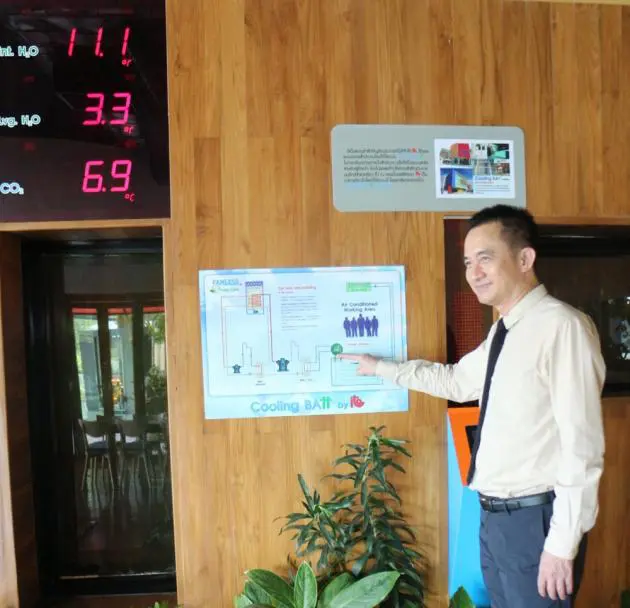
The team also succeeded in using pure carbon dioxide as a refrigerant to cool its own head office. The project for CPF also helped reduce electricity and water consumption. In 2008, the company won the National Outstanding Achievements Award for Science and Technology Research Development from the Prime Minister’s Office.
Business went smoothly even when Thailand plunged into a financial crisis in 1997. Though many businesses suspended their expansion plans, others still needed technicians to maintain their refrigerated facilities.
Apichai and his elder brother Apichit are the only founders who have stayed on. Both are satisfied with the slow but stable business story. From 11 employees, the company’s workforce has grown to about 150. Last year, the company generated some Bt600 million in revenue.
This year when the Thai economy remains sluggish, its goal is to maintain that level.
In the long term, prospects remain bright thanks to urbanisation. Soon, people will live further from markets.
This would encourage logistics companies to invest more in refrigeration systems that guarantees the freshness of food from distribution centres to sites near customers.
Refrigerated trucks will be more in demand. The award-winning CPF project also drew interest from other environmentally concerned companies.
“These clients are seeking a socially responsible image. They come to us for the same services,” he said.
