
Govt, consumer spending crucial to GDP growth this year: NESDB


Play
THAILAND'S ECONOMIC expansion has to rely on government spending and domestic consumption this year as export contraction in the first quarter dragged down growth in gross domestic product, according to the National Economic and Social Development Board.
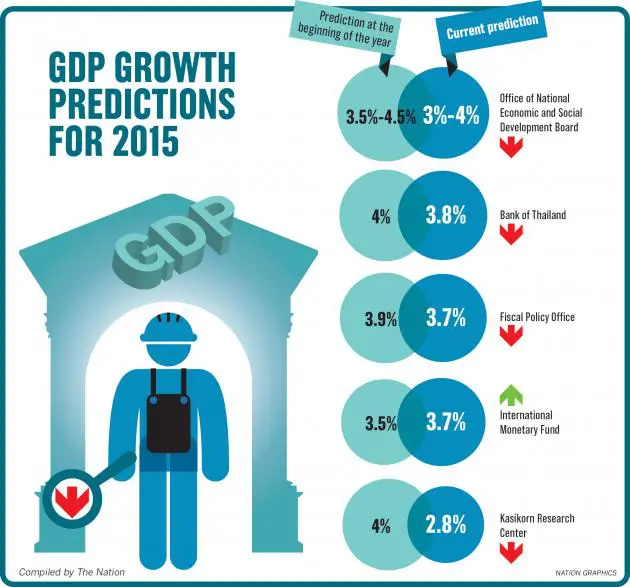
The NESDB yesterday lowered its GDP growth prediction from the range of 3.5-4.5 per cent to 3.0-4.0 per cent. Its report showed GDP only narrowly escaped a quarter-on-quarter growth contraction in the first three months, expanding by 0.3 per cent from the fourth quarter of 2014.
“The consecutive cuts in the policy interest rate have increased consumers’ confidence, but if we do not spend, the economy will not recover, and if the government does not spend, the private sector will not invest and consumer confidence will dissipate,” said Arkhom Termpittayapaisith, deputy transport minister and secretary-general of the NESDB.
GDP was able to expand by 3 per cent year on year in the first quarter of 2015, while the value and volume of the export of goods contracted by 4.3 and 2.6 per cent respectively. Exports account for 70 per cent of GDP, and the NESDB expects the sector to expand by only 0.2 per cent this year.
Total investment (private and public) expanded by 10.7 per cent. Public investment and consumption expanded by 37.8 and 2.5 per cent in the same period, while private consumption expanded by 2.4 per cent in the quarter. Collection of value-added tax grew by 1.0 per cent, sales of beer by 15.3 per cent, and consumer imports by 7.2 per cent. The construction sector expanded by 25.4 per cent, hotel revenue was up by 13.5 per cent and restaurants’ income grew by 2.3 per cent year on year.
However, the agricultural sector continued to decline, by 4.8 per cent.
“The government has to try to find a way to increase farmers’ productivity through ensuring an effective irrigation system, lowering costs of production and supporting the changes to higher-value crops such as sugar cane in order to improve the situation in the agricultural sector,” Arkhom said.
Bank of Thailand spokesman Chirathep Senivongs Na Ayudhya said the NESDB’s real-GDP numbers for the first quarter were close to what the central bank had projected, while government spending on investment and private consumption had expanded faster than expected. Nevertheless, the contraction in the export of merchandise was still a major drag in the expansion of the economy in the first quarter. Exports in the first quarter were down 4.69 per cent year on year to US$53.36 billion (Bt1.778 trillion).
“The quarter-to-quarter seasonally adjusted expansion shows that the economy is still weak, as it only expanded by 0.3 per cent and represents a slowdown when compared with 1.1-per-cent expansion in the previous quarter,” he said.
Economic risks
“The economic risks in the next period are from the continuous slowdown of production in the agriculture sector and the contraction in the export sector, which could pose risks to private consumption and investment.”
Pimonwan Mahujchariyawong, deputy managing director of Kasikorn Research Centre, said the NESDB’s GDP numbers for the first quarter were lower than what the research centre expected. However, the house will maintain its 2015 growth forecast at 2.8 per cent, as it expects things to be better during the rest of the year.
“We have to wait and see the effects from the consecutive cuts in the benchmark lending rate and the government stimulus measures, but we expect things to pick up in the remaining quarters,” she said.
“The government has to invest to increase private confidence, as exports are subdued and consumption is hampered by lower crop prices and the high level of household debt at 85 per cent to GDP,” Pimonwan said.
Tim Leelahaphan, Maybank Kim Eng Securities (Thailand) economist and assistant vice president of its research department, said the securities firm had just lowered its growth prediction for 2015 GDP from 4 per cent to 3.5-4 per cent after the NESDB announcement.
Tim said exports would not be the main driver for the economy this year.
“Consumption will not be positive every month, but it should still be a better economic driver than exports this year. The government needs to create confidence by spending on mega-projects,” he said.
“So far state spending has improved and most of the government investment projects are on track, so there is a possibility that the economy can rely on the government this year.”
Sanan Angubolkul, vice chairman of the Board of Trade of Thailand, said the economy was likely to show stronger growth in the second half of the year. The Board of Trade also expects GDP to grow by 3-4 per cent this year.
“This year the economy will not grow strongly, largely because of much lower oil prices, lower spending power, and small export growth, forecast at only 1 per cent this year. But the growth rate is acceptable and should be stronger next year,” he said.
Thanavath Phonvichai, director of the University of the Thai Chamber of Commerce’s Economic and Business Forecasting Centre, said the UTCC might soon lower its economic forecast, which it previously set at 3-3.7 per cent, on many negative factors.
