
Banthoon urges rivals to join KBank in cutting loan rates for sake of country


Play
BANTHOON LAMSAM, chairman and chief executive officer of Kasikornbank (KBank), yesterday called on fellow banks to follow its lead and cut their lending rates for the sake of the country, arguing that they should not act as barriers to economic growth.
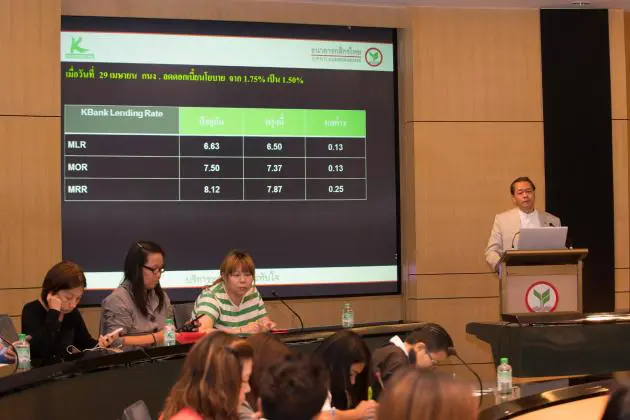
KBank is leading Thai banks this time around by cutting its lending rates by 13-25 basis points, effective today.
Its minimum retail rate (MRR) has been lowered by 25 basis points, from 8.12 per cent to 7.87 per cent per annum, while the minimum lending rate (MLR) falls 13 basis points, from 6.63 per cent to 6.5 per cent, and the minimum overdraft rate (MOR) is reduced by the same amount, from 7.5 per cent to 7.37 per cent.
“We are looking forward to hearing the action being taken by other banks,” he said.
Speaking at a hastily arranged press conference, the veteran banker criticised the response of the banking industry to the Bank of Thailand’s latest policy-rate cut, when it brought the rate down from 1.75 per cent to 1.5 per cent on April 29. “The central-bank governor has attempted to carry the economy forward, following a certain direction aimed at helping the country, while bankers should be following the central bank’s lead with acceptable figures [lower lending rates] and not remain silent, as they have been [on this occasion],” said Banthoon.
Meanwhile, SiamCommercial Bank (SCB) yesterday cut its MRR by 0.3 percentage point and 0.1 percentage point for MLR and MOR.
New rate of MRR will be set at 7.8 per cent, MLR and MOR at 6.525 per cent and 7.325 per cent respectively,
Bank of Thailand Governor Prasarn Triratvo-rakul on Tuesday met commercial banks’ chief executives during a Thai Bankers’ Association workshop, at which he asked for their cooperation in helping pass on the fruits of the latest monetary-policy move to the public.
Before KBank’s move on interest rates, no bank had taken any action following the Monetary Policy Committee decision three weeks ago to lower the policy rate by 25 basis points.
Yet, major banks had followed the central bank by slashing their lending and deposit rates following the previous cut in the policy rate, from 2 per cent to 1.75 per cent on March 11.
“For the sake of the country, bankers should not ignore the governor’s message, when he said it was time for thinking about the common interest,” said Banthoon.
“Enterprises will be successful in running their businesses after [receiving the benefits of] the rate cut, depending on their ability. But monetary policy should not be a barrier to the economy’s growth. Banks have a role in increasing confidence and opportunity among businesses,” he stressed. KBank’s chief also said monetary policy was a tool for enhancing the economy, while the government was attempting to play its part by speeding up its spending.
However, government spending cannot be executed as quickly as many would like, because governance issues have to be carefully considered first.
Therefore, it is essential for the central bank to use monetary policy to help the country, even though a policy-rate cut alone will not solve the nation’s economic problems, he explained, adding that monetary policy is used as a tool in sustaining the economy in many global markets.
“The government is attempting to help the country in whatever ways it can, while the banking sector should make a powerful contribution to the public and the economy by trimming interest rates,” he argued.
Meanwhile, Vorapak Tanyawong, president of Krungthai Bank, said yesterday that his bank had no plan as yet to cut its lending rates, as its benchmark lending rates were lower than those of its peers.
“To [consider] lower lending rates, KTB will need to review each bank’s asset yields as well. KTB and Bangkok Bank have lower asset yields already, reflected in lower loan pricing,” he said.
KTB’s benchmark lending rates yesterday stood at 6.625 per cent, 7.375 per cent and 8 per cent for MLR, MOR and MRR, respectively.
Referring to the economic and financial crisis of 1997, Banthoon said the banking system had still managed to function and play a role during those difficult times.
The situation now is nothing like as extreme as in 1997, and the banks should therefore talk about lower interest rates, although it was true that they would lose a certain amount of income by trimming their lending rates, he said.
Banthoon said the central bank was currently under pressure, as questions were being asked as to why it was not helping to depreciate the baht’s value or injecting money into the economy in order to drive growth.
“It is not easy for the central bank in find the right balance. We cannot know what is the most suitable figure for the policy rate, or the baht’s value against the US dollar. We will only know when we see the results of the execution [of its policy],” he added.
