
Manufacturing business has rubber farmers' interests firmly at heart


EXPANDING the number of farmers selling their rubber products directly to the company's manufacturing plant is the business strategy of TK Charoenrungrueng Registered Ordinary Partnership this year, founder and manufacturing manager Kasem Suksom told The
Rubber farmers in Si Sa Ket province traditionally sell their latex and rubber sheet to middlemen rather than directly to manufacturers, and get a below-market price as a result. This persuaded Kasem to resign from his position at Yokohama Rubber (Thailand) in Rayong province in 2002 to establish his own business and directly support rubber farmers in his home province of Si Sa Ket.
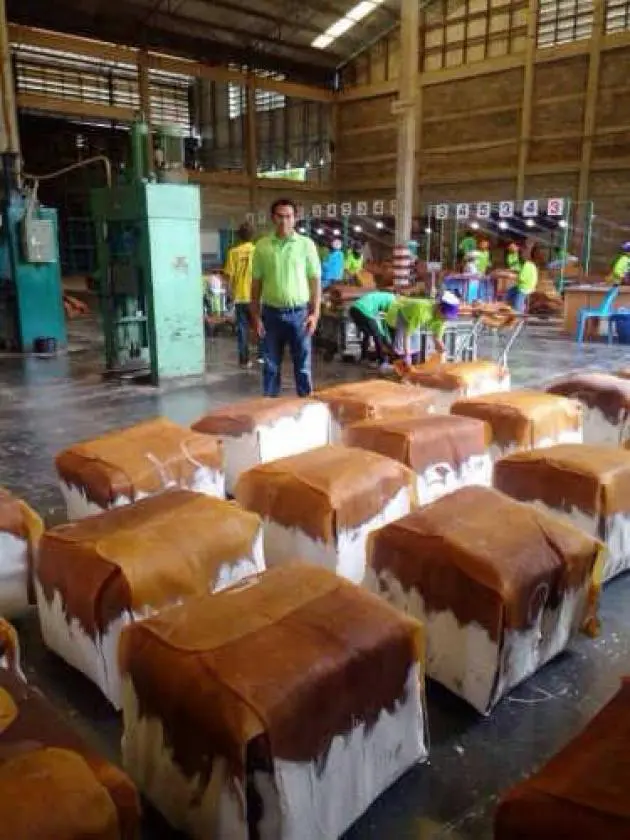
He started out as a trader by buying rubber products from Si Sa Ket farmers to sell directly to a factory in Rayong province, but 10 years later was given a new opportunity by a businessman, Thana Tangwongchai, who provided Bt60 million to construct a plant in Si Sa Ket on a 20-rai (3.2-hectare) plot for the production of rubber stone, which is used for flooring and paving.
The plant has the capacity to produce 1,600 tonnes of rubber stone per month.
“Our plant started full operation last year, and buys an average of 800 tonnes of rubber a month from farmers in Si Sa Ket and neighbouring provinces,” he said.
Si Sa Ket alone has more than 28,400 rubber farmers and a rubber-plantation area of just over 300,000 rai.
The company’s objective is to do business by supporting rubber farmers to sell their output directly to the factory, enabling them to get the market price and also cut the cost of transport to its plant, Kasem said.
Normally, it costs an average of Bt2 per kilogram to deliver rubber from the plantation to a factory, but when the farmers sell to TK Charoenrungrueng, they pay less than 50 satang per kilo, and the company will in many cases collect from the farm, he explained.
Besides helping rubber farmers to lower their transport costs, the system has the benefit of stabilising the price of rubber in the province to close to market levels at a time when prices have slumped after an overall drop-off in demand, he said.
“Our business strategy forms part of efforts to integrate the rubber process in the province from the plantation to the manufacturing plant, cutting farmers’ costs and also creating sustainable prices for rubber businesses in the province,” said the company founder.
TK Charoenrungrueng transforms latex, rubber sheet and smoked rubber sheet into rubber stone, which is then sent to its partner, Sri Trang Agro-Industry, Thailand’s largest producer and distributor of rubber products.
“We generate net income averaging 60 satang per kilogram of rubber stone, which is enough to operate the business. But it is not only about the income we receive from the business, as our challenge is to create jobs and also support rubber farmers to reduce their costs and build sustainable business for our province,” he said.
In the next step to drive its business for the long term, Kasem will promote TK Charoenrungrueng’s plant to buy even more rubber products directly from farmers on a mutually beneficial basis.
“We have joined with the Office of the Rubber Replanting Aid Fund of Si Sa Ket province to promote our plant to rubber farmers in the province and neighbouring provinces, for the sale of their products directly to us.
“This will boost our production from just 800 tonnes a month, which is half of our overall monthly capacity of 1,600 tonnes. This will boost our revenue and also support our farmers to earn more from this system,” he said.
