
Traders to tackle trafficking


THE BOARD of Trade of Thailand and the Thai Chamber of Commerce, along with four fishing-industry associations and leading players in the sector, yesterday vowed to continue strenuous efforts to solve the problem of human trafficking and other labour issu
The target is not only to unlock Thailand from its current poor status in both US and European Union evaluations of labour issues, but also to promote the Kingdom’s image and sustainable growth of the industry.
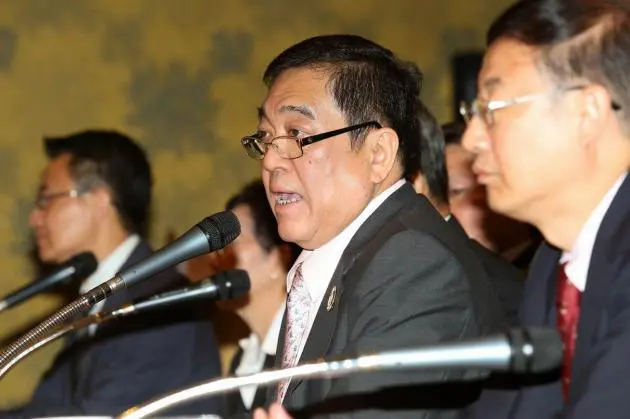
The Thai Frozen Foods Association (TFFA), along with trade bodies representing food processors, the tuna industry and the shrimp sector, plus leading fishery enterprises Charoen Pokphand Foods, Thai Union Group and TRF Feedmill, held a press conference to support the government’s serious endeavour to tackle fishing and human-trafficking issues during the past year.
The announcement was designed to encourage operators throughout the seafood supply chain and production chain to commit to appropriate production practices in line with international standards.
The TFFA also revealed a measure to rid the Thai shrimp supply chain from illegal employment by announcing that it would use only shrimp and feed meal from legal processors at primary sources of production.
Poj Aramwattananont, vice chairman of the Board of Trade and TFFA president, said that with greater efficiency and tangible measures imposed by the government for combating problems related to illegal employment, in particular in regard to forced and foreign labour, Thailand expected the US would favourably consider upgrading the Kingdom’s status in its "Trafficking in Persons Report" (TIP) by the end of this month.
Moreover, the EU is not expected to attach the "red" (poorest) status to Thailand in its upcoming illegal, unreported and unregulated (IUU) fishing review, scheduled to be released in October, he said.
"We [businesses] expect that the US and the EU will fairly consider upgrading Thailand’s status during the upcoming revisions," said Poj, adding that the government had made strong efforts to solve labour problems during the first year of its administration.
He said that regardless of whether the US upgraded Thailand’s status in its upcoming TIP report, private enterprises and the government would continue their efforts to resolve the problem of illegal employment and improve the Kingdom’s image and ensure sustainable development in the fishery industry.
In yesterday’s statement, the private sector said Thailand now had concrete and tangible plans to solve many issues related to illegal employment and the enhancement of human-rights protection.
The country now has a national committee and a one-stop service to solve labour problems, as the government sees the issue as a national-agenda item, it said in the statement.
The government has also taken steps to amend both the fisheries and human-trafficking laws for the first time in many years, showing its serious attempt to stringently enforce laws and punish illegal enterprises.
Moreover, private enterprises have been alerted to commit to discontinuing the purchase of aquatic products from unregistered, illegal and unregulated fishing, along with the production line from upstream to downstream industries involving feed meal, primary processing, processing plants and export procedures.
Raw-material commitment
To rid the sector of illegal fishery processors and producers, the TFFA will implement a new measure to enforce its members – and primary processors, or peeling-shed plants, in particular – to commit to legal raw-material usage.
Any enterprises not complying with the association’s’ condition could have their membership terminated, and would then be unable to engage in any export activity.
Panisuan Jamnarnwej, emeritus president of the TFFA, said that despite the sector being the subject of intense monitoring in respect of labour problems, Thai seafood exports had not decreased during the past year, due to the low global supply of seafood products.
The sector has also managed to achieve this despite the baht’s appreciation against the euro, resulting in higher-priced seafood exports to the EU, he said.
He added that the expiration of GSP (generalised system of preferences) benefits for Thai products exported to the EU early this year had had more of a direct impact on Thai export competitiveness than illegal-labour issues since most importers, in particular supermarkets, still had high confidence in the country’s fishery industry as they regularly inspected Thai fishery plants and supply chains.
Rittirong Boonmechote, president of the Global Shrimp Business Unit of Thai Union Group, said Thai businesses would not only take steps to comply with international standards related to the fishery industry, but would also be more concerned about sustainable growth of the sector, which would in turn ensure environment production.
Coming from one of the world’s major seafood-supplier nations, Thai operators will learn to adopt increasingly sophisticated technology and standards to ensure fair practice for labour, the environment and sustainable growth of the fishery industry, he said.
