
China's greenhouse reduction bill 'could reach US$6.6 trillion'


China's post-2020 climate action plan will be "quite ambitious" and may involve an estimated investment of more than US$6.6 trillion (Bt222.82 trillion) by 2030, according to a lead climate negotiator.
The action plan is to be announced by the end of this month.
The country’s intended nationally determined contribution will differ from those of other countries because it will announce a series of objectives in addressing climate change up to 2030, Xie Zhenhua said.
Xie, the special representative for climate change affairs, was taking part in the Strategic and Economic Dialogue forum in Washington, DC.
"Not only will we have objectives in our intended nationally determined contribution [INDC], we will also cover a lot of policy issues and projects to reach these objectives.
"I believe that after China’s announcement of its INDC, you will see that our objectives are quite ambitious," Xie said at a media briefing. He also said it was likely to cost the country more than 41 trillion yuan to meet the greenhouse gas reduction goals.
An official at the National Development and Reform Commission, who did not want to be
named, said, "The 41 trillion yuan is a rough estimate from experts.
"The figure largely refers to investment in promoting energy conservation and efficiency in industry, transportation and construction as well as investment in nuclear and renewable energy by 2030," the official said.
In a joint announcement by Chinese President Xi Jinping and United States President Barack Obama in November, China set targets for carbon dioxide emissions to peak around 2030 – and to increase the share of non-fossil fuels in primary energy consumption to about 20 per cent by that year.
Chinese Vice-Premier Wang Yang said recently China’s core action in tackling climate change from an economic perspective was to "shift its growth model", adding, "We must change our philosophy of ‘pollution first and solution later.’’
The environmental industry’s output in China has grown by 50 per cent year-on-year, generating more than $700 billion. More than 750,000 new-energy vehicles were sold last year, three times the number in 2013, providing growth opportunities for many companies.
Dangerous pollution
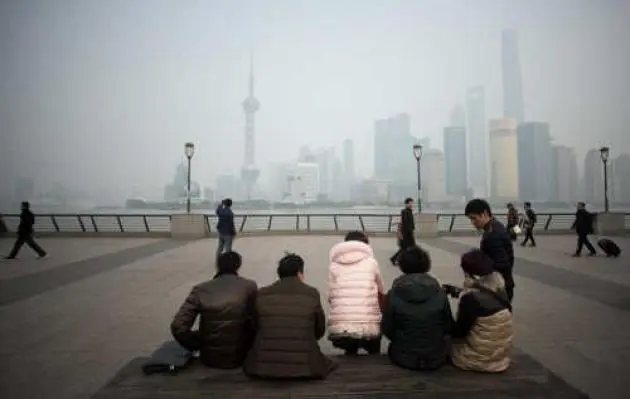
Several parts of the country have suffered from serious pollution. While the air quality in Beijing is notorious, pollution in offshore waters reportedly remains high too.
More than 15 per cent of coastal water is heavily polluted and is categorised as below Level IV – the lowest water quality level according to national standards, said China’s Oceanic Development Report (2015), issued by the State Oceanic Administration.
"Severely polluted offshore waters are mainly concentrated in large estuaries and bays," said Jia Yu, deputy director of the China Institute for Marine Affairs. "The East China Sea remains the most polluted, with 46 per cent of sea area below Level IV. It is also notable that pollution in the South China Sea shows a significant increase from 2010 to 2013," it said.
In order to control pollutants, the Plan for Ecosystem Protection (2013-20) introduces preventive measures, including establishing ecosystem marine red lines and national marine parks, and sets goals for restoring the marine environment in the near future. The severe pollution in the offshore region has attracted growing attention from other authorities.
The Ministry of Environmental Protection has released the second draft of regulations capping exhaust emissions from vessels.
The Transport Ministry has also released the draft of an action plan to control the pollution from vessels and at the coastal regions from 2015 to 2020, which is expected to be implemented within the year.
