
Stimulus 2 draws positive response


Play
THE FEDERATION of Thai industries (FTI) has welcomed the Bt206-billion second phase of the Council of Economic Ministers' economic stimulus package, which is aimed at supporting small and medium-sized enterprises (SMEs).
FTI chairman Supant Mongkolsuthree believes it could increase SMEs’ liquidity and boost the number of new start-ups.
The Bt136-billion first phase of the stimulus package, aimed at helping low-income earners, was approved by the Cabinet last week.
“The SME measures that were approved [yesterday] will help SMEs, as they are well-rounded and cover the full loop of everything from allowing SMEs to gain further access to finance, to increasing profit via lowering their income tax and encouraging new businesses through a government venture-capital programme and the tax exemption for new targeted businesses,” Supant said.
“Nevertheless, the effectiveness of the loan measures will be determined by the response of the financial institutions and SME operators, and I still urge the government to come up with more measures to mitigate the further drop in commodities prices, since the more purchasing power the farmers have, the more products they will buy from SMEs,” he added.
Supant also praised the fact that the new small government projects worth Bt16 billion, which form part of the first phase of the stimulus package, will concentrate on getting supplies from SMEs, as this would create jobs for SMEs and support the second phase of the package.
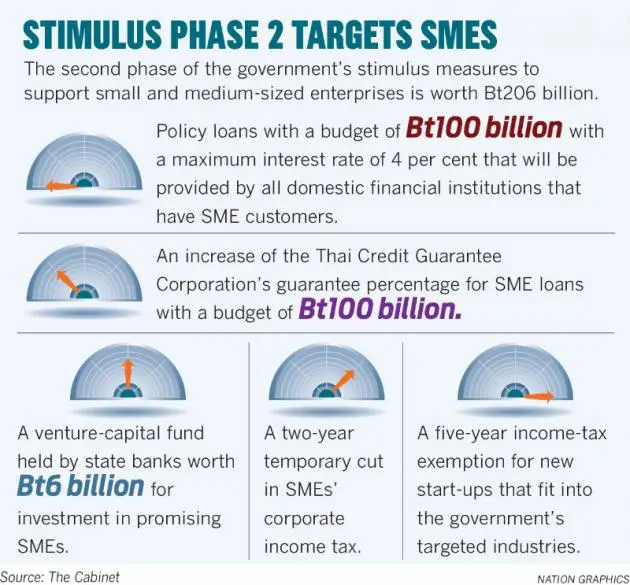
The SME-support package approved by the Cabinet yesterday includes a policy-loan programme with a seven-year term and a budget of Bt100 billion to be provided on a first-come, first-served basis by the Government Savings Bank (GSB) as 0.1-per-cent-interest loans to any legal and regulated domestic financial institution that has SME customers, the financial capability and is willing to comply with the conditions before they can be re-lent to SME customers at an interest rate of no more than 4 per cent.
Chatchai Payuhanaveechai, director of the GSB, said the bank could begin to supply the budget to financial institutions by next week, and the government would have to compensate GSB in terms of interest to the tune of around Bt2.8 billion annually for the seven-year term.
The GSB has also come up with measures to allocate Bt1 billion of the Bt100 billion in soft loans to fishing-vessel owners for the change of equipment and to buy radar to tackle illegal fishing. and another Bt7 billion to support
The GSB has around Bt2 trillion worth of savings and excess liquidity of about Bt300 billion, so it will be definitely be able to support the Bt130 billion required of it to support the latest round of stimulus measures, said Chatchai.
Among the other measures agreed yesterday is to increase the Thai Credit Guarantee Corporation’s (TCG) loan guarantee provided to SMEs.
The TCG’s 70-per-cent guarantee, with commercial banks taking the credit risk for the remaining 30 per cent, will remain, but the banks will provide an extra 15-per-cent guarantee for the first set of non-performing loans and another 7.5 per cent for the second batch.
“We have talked to the private sector and the commercial banks have revealed that they can accept the new credit risk, and I believe and if they can accept it, then |commercial banks will begin to release more loans to SMEs,” said Finance Minister Apisak Tantivorawong.
“The guarantee fee for SMEs will also be lowered to zero in the first year, 0.5 per cent in the second year, 1.5 per cent in the third year and the full 1.75 per cent for the remaining term, and the government will have to compensate around Bt4 billion to the TCG,” he added.
Another measure is a venture-capital fund with a budget of Bt6 billion to be contributed by the GSB, Krungthai Bank and SME Bank as equity seed money for SMEs with insufficient capital to start up.
The package also includes tax measures to cut SMEs’ corporate income tax from 15 per cent to 10 per cent for those with a net profit of Bt300,000 to Bt3 million for two accounting periods, while SMEs which have to pay 20 per cent will have the rate cut to 10 per cent for the same period.
Another tax measure is a five-year tax exemption from the previous 3 per cent that was offered by the Board of Investment for SME start-ups in industries deemed “beneficial to the country and with high technology and innovation costs”, such those in the service sector, tourism, IT and processed agricultural products.
The Office of Small and Medium Enterprises Promotion will determine which industries and businesses will receive the tax exemption and the list will be announced shortly, said Deputy Prime Minister Somkid Jatusripitak, who spearheaded the latest round of stimulus packages under the “Start-up Nation” theme.
