
Thai economy needs structural changes to cope with 'new normal': Prasarn
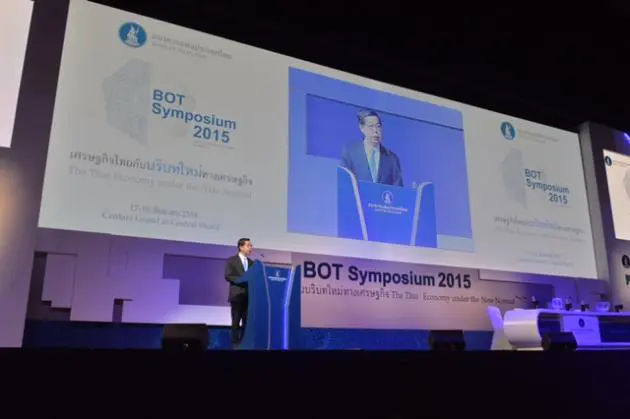


The Thai economy must undergo structural changes in line with the "new normal" in the global economy, said Bank of Thailand Governor Prasarn Trairatvorakul, and these changes cannot be in demand-side policy only.
For Thailand, the new normal consists of four main elements: the slowdown in global trade, low inflation, increased financial connectivity and the ageing population, Prasarn said in a keynote speech at yesterday’s "BOT Symposium 2015".
He also said the eventual increase in the United States’ key interest rate would probably have limited impact on Thailand.
"Government policies are playing an important [role] under the current global structural changes with the introduction of short- and medium-term measures and the introduction of proactive measures to strengthen the economy long-term," he told the symposium.
"We cannot replace the need for structural changes in the economy with demand-side policy, which only offers short-term solutions and cannot push the economy towards the new norms in a sustainable way."
Prasarn pointed to the example of the country’s export sector, which required structural changes in terms of Thailand’s position in the global supply chain.
"Activities in the supply chains with high added value take place before and after production, but activities in Thailand are mostly in the production process, while most activities entailing higher added value are being managed by foreign companies," he said.
"Nevertheless, the steps towards the new normal should not concentrate on reform of the export sector only, since that will not answer the question completely. The slowdown in the expansion of the economy is related to all sectors."
Prasarn said changes were needed in both the private and public sectors, as the former had to increase its productivity continuously while the government had to improve its efficiency.
"The development of Thailand’s government efficiency needs to be accelerated. This has to start with the operations of the state-owned enterprises, which are large and are in control of the country’s strategic assets … Therefore if the state-owned enterprises are inefficient, then the country’s economic potential will be tarnished," he said.
Meanwhile, Prasarn said one of the reasons the BOT’s Monetary Policy Committee maintained the benchmark interest rate at 1.50 per cent was that it did not want to add any more uncertainty to the money markets.
He said the effect on capital outflows from the anticipated US interest-rate increase was expected to be minimal, since Thailand’s foreign debts of around US$130 billion are lower than the international reserve, at $170 billion, and 30 per cent of the foreign debt is in baht.
"Foreigners who wish to sell Thai government bonds or the BOT’s baht bonds will have to sell them in baht, and if they want to transfer the capital abroad, then they have to change the baht into US dollars anyway. The [reserve of] $170 billion is obviously higher than $130 billion, while 30 per cent of the $130 billion is in baht, so people have confidence when they are looking in," he said.
Foreign ownership in the Thai bond market only accounts for 8 per cent. The stock market has around 30 per cent foreign ownership, but these are mostly long-term strategic owners. The capital market has tools to manage sudden short-term outflows if necessary, he added.
