
Emerging markets adopting 'digital wallet' for payments


The digital wallet is driving payment innovation in emerging markets including Thailand, according to MasterCard.
And the Asia-Pacific region has been named among the world’s top shopping destinations for Muslim travellers.
Ann Cairns, president for international markets, said yesterday that innovative payments and online transactions could be seen in some of the biggest emerging countries such as India, China, Indonesia, Malaysia and Nigeria, as well as the United Arab Emirates.
Thailand is one of the key markets driving the growth of online payments, as 100 per cent of Thais now own a mobile phone but only 30 per cent use a smartphone, so there’s room to grow.
And compared with South Africa, online shopping is still rare, while 90 per cent of people in Egypt prefer to pay in cash rather than by credit or electronic channels.
MasterCard is looking into facial-recognition software that would allow people to use a selfie to complete a transaction to cope with the trend in developed and emerging countries.
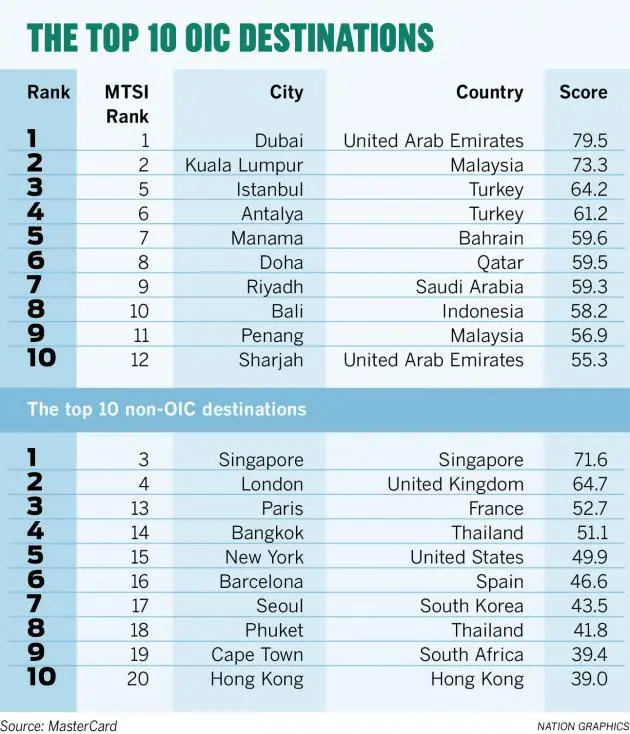
MasterCard yesterday revealed its second annual MasterCard-CrescentRating Muslim Travel Shopping Index, which found that many cities in the Asia-Pacific region had become top shopping places for Muslims.
CrescentRating is an authority on halal-friendly travel. Its vision is to lead, innovate and drive this segment through practical and guidance on all aspects of halal-friendly travel to organisations across the globe.
According to the survey, Muslim tourists spent US$62 billion (Bt2.3 trillion) on shopping and dining last year.
Dubai topped the ranking for overall Muslim travel shopping with a score of 79.5, followed by Kuala Lumpur with 73.3.
Singapore scored 71.6, making it the top city among non-Organisation of Islamic Cooperation countries and third overall. Bali also made into the top 10 destinations, scoring 58.2, closely followed by Penang with 56.9.
The Asia-Pacific region contributed 14 cities to the overall top-40 list.
A significant highlight of the survey was the high number of non-OIC countries featuring in the top-40 list.
Singapore secured a rank among the top five overall destinations for Muslim traveller shopping. This further revealed the potential for non-OIC destinations, with 25 on the list, to attract Muslim travellers by proactively catering to this segment.
The report looks at in-depth data covering Muslim travel shopping from 40 international cities creating an overall index, based on a number of criteria.
It is the first time detailed insights have been provided on the consumer spending behaviour of Muslim travellers.
"The MasterCard-CrescentRating Muslim Travel Shopping Index is a fascinating insight into the shopping habits of Muslim consumers and will prove to be an invaluable tool to the entire sector," said Fazal Bahardeen, chief executive officer of CrescentRating & HalalTrip.
The index reveals how important the Asia-Pacific region is to the sector and the vital contribution they are making.
"We see this as an important resource not only for us to better understand this significant and fast-growing traveller segment, but also to inform and support the efforts of our partners in the travel industry," said Matthew Driver, executive for Asia-Pacific global products and solutions at MasterCard.
This is forecast to grow to 150 million visitors by 2020 and 11 per cent of the market segment with a market value projected to grow to $200 billion.
