
Entrepreneur aims to make Purinoki a regional health brand
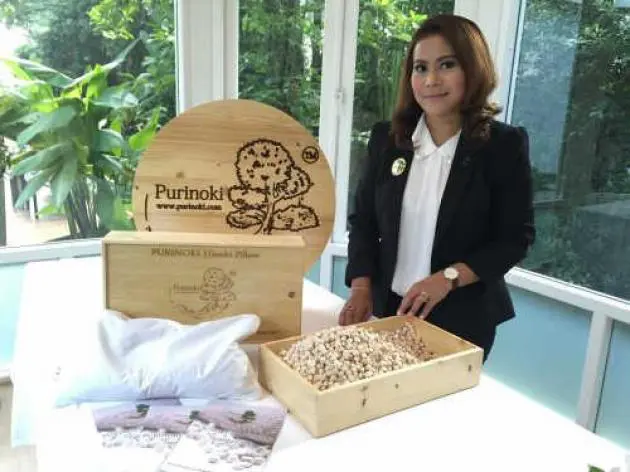


STARTING in business when she was 23, Ploynapat Pattaranapatsri, managing director of P&M Intertrading, her second company, has set an ambitious goal of making her Purinoki brand a regionally recognised health-product brand.
Her first company, Sereephan Partnership, operates in two fields: digital printing on demand, and supplying educational products for schools in Khon Kaen and nearby provinces.
This business has to take into account schools’ needs under government policy, while after-sales service is key to success as an educational supplier, she said, raising the official “15-Year Free Education with Quality” programme as an example of how to benefit from government policy.
Moreover, two years ago, she predicted that the upcoming Asean Economic Community would spur huge demand for AEC flags in schools, and her forecast has proved correct, she said.
In fact, trading is something Ploynapat has been familiar with since her school days. Being from a poor family in Khon Kaen province, with no steady income, she had to work to pay for her education, while also generating additional income from trading goods at her school.
After graduating with a high-vocational certificate, she initially worked as a clerk on a monthly salary of Bt2,700 at a company in Khon Kaen, while also being a life-insurance agent in her spare time in the hope that it would bring in more income than being a permanent member of staff at the firm.
“But what I learned from being a life-insurance agent was the benefit of going on training courses, which motivated me to know how to value oneself. Later, I joined many free training programmes via acting as an agent for several insurers, because those courses I regarded as business schooling for me,” she explained.
Ploynapat suggested that anyone with a small enterprise, but with little or no idea about how to run a business, should take a course or courses to broaden their knowledge.
They should also become a member of both their provincial chamber of commerce and a foreign chamber, in order to build connections.
Moreover, if the chamber and/or the government organised a roadshow overseas, it would be easier for the small operator to grasp the business opportunity, she added.
In regard to her second company, Ploynapat said that while P&M Intertrading was only founded early this year, she had spent around eight years negotiating with the concession holder for hinoki pillows in South Korea.
The idea behind forming P&M Intertrading began when she visited Japan and wondered why its people generally lived longer than those elsewhere, and why most onsen baths – the most popular natural hot spring in Japan – used hinoki wood.
Hinoki cypress is conserved in Japan, but this type of wood is available for sale in South Korea, where the government has granted a concession to a private company to distribute it.
Hinoki wood chips are used to make a form of pillow, which is popular in South Korea because the phytoncide from the Hinoki tree decreases stress-hormone levels and kills bacteria.
Her company is only the second exclusive licensee in Asia to distribute hinoki pillows in Thailand, for which she has created her own brand – Purinoki – because she wants the brand to represent products with health benefits.
Her Purinoki pillows are aimed at the health-conscious niche market segment, especially among those with medium to high incomes.
The pillows cost between Bt3,290 and Bt4,290 apiece, depending on the size.
P&M Intertrading also plans to bring other hinoki-containing products such as shampoo and soap for the body and face to the Kingdom soon, she said.
As a small business, she acknowledged that she did not have much of a marketing budget for promoting the products, although the public definitely needed to be educated about the benefits of Hinoki-based items.
Positive feedback
The company initially opened for pre-orders via online channels, including Facebook. Feedback was overwhelming and she now plans to promote the pillows in hospitals and other healthcare outlets.
P&M Intertrading plans to offer exclusive distributorships in four Thai regions as it hopes that around 10 per cent of the population will use the Purinoki pillow within three years, generating sales of around Bt2 billion, Ploynapat said.
While Sereephan Partnership is focused on local trading, her objective for P&M Intertrading is that it should also be involved in international trading and for Purinoki to be recognised as a regional health-product brand, she said.She hopes to expand sales of Purinoki pillows and related products to Laos, Myanmar and Vietnam, because of their large combined population and the growing number of wealthy individuals.
“We have to spread the brand and products speedily because we don’t have competitors yet. We don’t know what will happen in the future, therefore what we can do is strongly promote the product and brand of Purinoki in both Thailand and neighbouring countries.”
She added that she hoped to see consumers in all these markets recognise Purinoki as a regional health-product brand.
Banks have supported a term loan and overdraft for P&M Intertrading, and they want her company to upgrade from a small enterprise to a medium-sized business.
However, she is happy for the time being for the firm to be deemed a small business until it is stable enough to grow into something bigger.
