
Banking fees to reflect cost of service in move to reduce the use of cash


BANKS' fees are poised for a change to better reflect actual costs and pave the way for a cashless society.
“The structure is distorted. The fees for paper-based transactions are very cheap, compared to the associated cost. Banks are now cross-subsidising them with fees collected from electronic transactions,” Veerathai Santiprabhob, governor of the Bank of Thailand, said in a recent interview.
While the cheque fee is only Bt15, the actual cost is far more. Customers can withdraw money from an ATM without any fee, but banks carry a huge cost for cash management at ATMs, he said.
Anuchit Anuchitanukul, adviser to the Finance Ministry’s National e-Payment project, has said that Bt7 trillion is withdrawn from ATMs each year. Banks spend over Bt10 billion on armoured vans and other expenses to fill up ATMs.
The project aims to reduce cash usage. This will require the creation of more points of sale across the country, as now there are fewer than 100,000, versus the minimum of 2 million as recommended by the Bank of Thailand’s study.
To maintain their retail customer base, banks are expected to compete in reaching out to merchants to establish their own points of sale. Small merchants will also require mobile points of sale or mPos to support their small customers.
Under the project, companies registered with the Commerce Ministry cannot deny e-payments.
Banks are now offering electronic payment services through different systems. The cross-system operations result in higher charges for consumers.
While the project will help reduce cash transactions, authorities are considering the next step – a central settlement house to oversee cross-bank transactions through ATM cards, the Internet and debit cards.
“The central system will be a superhighway. It will be the single gateway for all banks and state agencies,” he said.
Further facilitating the move to a cashless society will be the Any ID e-payment module – a collaboration of the Finance Ministry and the central bank. It will allow anyone to transfer money by using his ID card, mobile number or email address.
Veerathai said the central e-payment settlement agency and the Any ID module should be completed by the third or fourth quarter of next year.
With a single e-payment system, banks will experience a drop in operating fees and this would lead to a drop in fees that end-users have to pay.
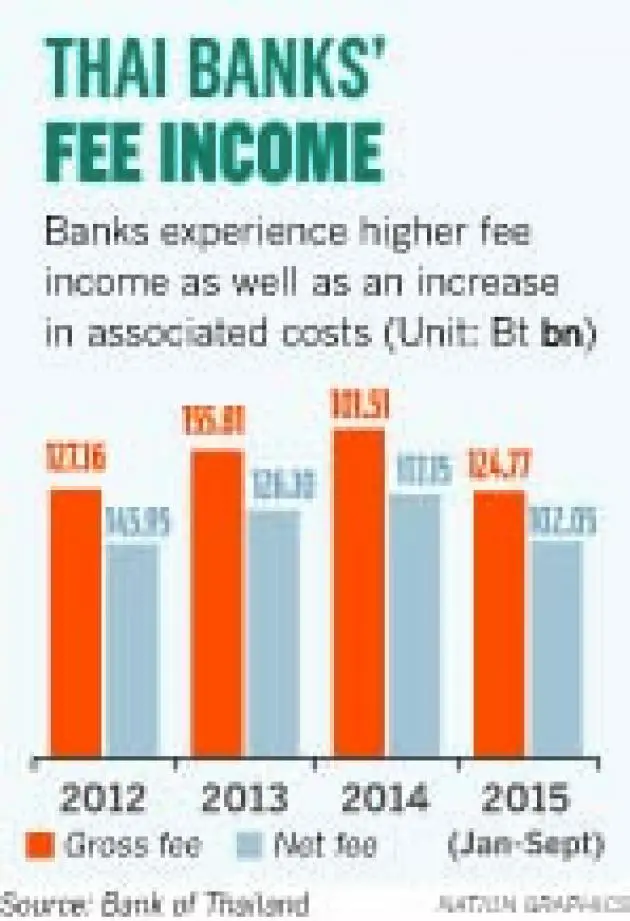
Banks have enjoyed an increase in fee income from Bt127 billion in 2012 to Bt155.8 billion last year.
Fee income minus operating costs has also risen from Bt101.51 billion to Bt124.77 billion, according to the central bank.
Contributors to fee income
Credit cards now contribute 18 per cent of the fee income, followed by ATMs and other e-banking services at 17 per cent. In the first nine months of this year, gross fee income reached Bt126 billion and net fee income Bt102 billion, indicating that banks spent as much as Bt24 billion on operations.
The infrastructure gateway is expected to reduce associated costs.
Under the current system, senders are charged for transferring money. Under the new scheme, both senders and recipients will shoulder a fee. This is expected to lead to competition among banks to retain customers.
The scheme looks possible to implement successfully, thanks to the proliferation of smartphones, which are estimated to account for over half of phones in use in the country.
Cheap prices have boosted their popularity as well as faster mobile data services. Soon, smartphone use would be 100 per cent.
“Years ago when the video player was launched, I would laugh if someone said all houses would have one. Likewise, when it comes to smartphones, it is not beyond the realm of possibility for all Thais to own a smartphone one day,” Anuchit said.
Consumers are expected to support the changes, since they are the ultimate beneficiaries.
