
China’s West Coast of Opportunity: 3 Cities Fuel Thai Trade Expansion
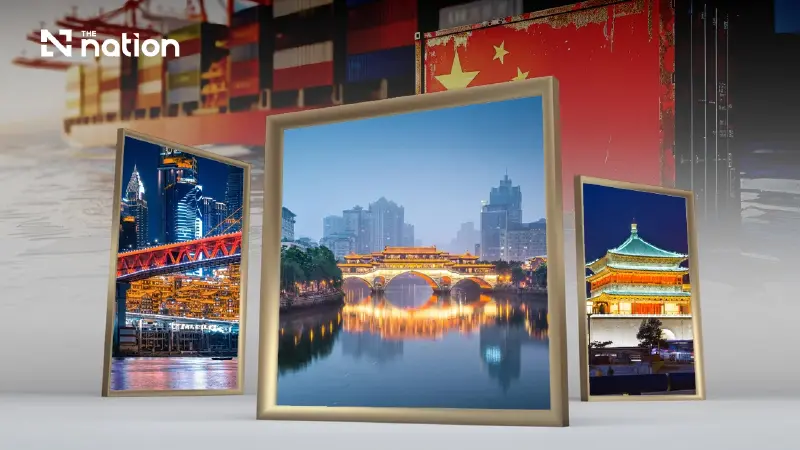


Western China’s emerging megacities offer Thai businesses a strategic gateway to high-tech supply chains and European trade routes
- Three cities in Western China—Chongqing, Chengdu, and Xi’an—are identified as a "Western Triangle" creating a new commercial frontier for Thai businesses.
- Each city offers a distinct role for Thai trade: Chongqing for advanced manufacturing and B2B partnerships, Chengdu as a gateway for consumer and lifestyle products, and Xi'an for high-tech supply chains.
- The region provides a strategic opportunity for Thai exporters to integrate into high-tech production networks and leverage direct rail infrastructure to reach Central Asian and European markets.
Western China’s emerging megacities offer Thai businesses a strategic gateway to high-tech supply chains and European trade routes.
As China kicks off its 15th Five-Year Plan in 2026, its economic centre of gravity is shifting away from traditional industrial hubs on the eastern seaboard and moving decisively westwards.
For Thai businesses navigating intense coastal competition, inland China’s "Western Triangle"—comprising the powerhouses of Chongqing, Chengdu, and Xi’an—presents a transformative commercial frontier.
Recent economic data compiled by the Department of International Trade Promotion (DITP) highlights a profound structural pivot across the region. Rather than relying on heavy infrastructure investment, China’s interior is rapidly morphing into a high-tech powerhouse driven by advanced manufacturing, digital innovation, and premium consumer demand.
In the first half of 2026 alone, China’s national GDP expanded by 4.7 per cent to 69.57 trillion yuan, with high-tech manufacturing surging by 13.3 per cent.
Strikingly, output of 3D printing equipment jumped by 48.5 per cent, lithium-ion battery production grew by 39.3 per cent, and industrial robotics output surged by 28.0 per cent.
Far from competing directly, Chongqing, Chengdu, and Xi’an operate as a complementary "three-engine model", creating an interconnected network spanning production, technology, logistics, and international trade.
WESTERN CHINA'S ECONOMIC TRIANGLE

1. Chongqing: The Advanced Industrial Giant
Maintaining its title as China’s fourth-largest city economy, Chongqing registered a first-half GDP of 1.67 trillion yuan. The municipality has established itself as an advanced industrial powerhouse, posting a 63.2 per cent jump in lithium-ion battery manufacturing and a 66.9 per cent surge in automobile and components exports. Leading national retail sales at 849.1 billion yuan, Chongqing offers Thai firms an ideal base for industrial B2B integration, raw material supply, and large-scale retail distribution.
2. Chengdu: The Innovation and Consumer Hub
Posting 5.0 per cent GDP growth to hit 1.28 trillion yuan, Chengdu’s economy is anchored by a dominant services sector that accounts for nearly 70 per cent of municipal output. Dubbed a "Park City" with a strong draw for young talent, Chengdu excels in financial services, software, and lifestyle consumption. For Thai brands, the city serves as the premier consumer gateway for lifestyle products, functional foods, wellness, and modern services.
3. Xi’an: The High-Tech Gateway to Global Markets
Xi’an emerged as the standout trader in early 2026, with import and export values skyrocketing by 96.2 per cent to 450.2 billion yuan—the fastest growth rate among China’s top 20 trading cities. Memory chips and integrated circuits accounted for over three-quarters of this surge. With deep strength in aerospace, defence, and electronics, Xi’an serves as a vital bridge connecting inland China to Central Asia and Europe via the China-Europe Railway Express.
Key City Strengths at a Glance
|
City |
Primary Economic Focus |
Key Growth Sectors |
Thai Business Opportunity |
|
Chongqing |
Advanced Manufacturing & Logistics |
New Energy Vehicles, Lithium Batteries, Smart Equipment |
B2B industrial partnerships, automotive components, raw materials |
|
Chengdu |
Services, Retail & Innovation |
IT/Software, Modern Services, Consumer Goods |
Lifestyle brands, functional foods, healthcare, modern services |
|
Xi'an |
High-Tech & Cross-Border Trade |
Semiconductors, Integrated Circuits, Aerospace, Rail Freight |
High-tech supply chain integration, cross-border e-commerce |
A Strategic Shift for Thai Trade
For Thai exporters, tapping into Western China requires a fundamental shift in strategy: moving away from viewing the region merely as a sales destination towards using it as a strategic supply chain link.
By establishing a presence in this inland hub, Thai businesses can integrate into regional production networks while leveraging direct rail infrastructure to reach broader European and Central Asian markets.
To succeed in this evolving landscape, Thai companies must move beyond price competition. Capturing China's growing high-value consumer market will require premium product positioning—emphasising stringent safety standards, sustainable practices, sophisticated packaging, and compelling brand storytelling, particularly within the fast-growing functional food and wellness sectors.
