
Loxley plant in Bang Pakong ready to make electric vehicles


Play
LOXLEY, a leading Thai trading conglomerate, has said a joint venture Loxley-BYD assembly plant in Bang Pakong, in Chachoengsao, is ready to produce electric vehicles with zero emissions and energy saving for the Thai market.
Early this year, Loxley in partnership with BYD Auto Industry, a Chinese manufacturer of automobiles and rechargeable batteries imported K9 electric bus and E6 passenger vehicles for sale.
Meanwhile, Loxley collaborated with public and private organisations including the Metropolitan Electricity Authority, the Provincial Electricity Authority, Bangkok Mass Transport Authority, King Mongkut’s University of Technology Thonburi, King Mongkut’s Institute of Technology Lat Krabang, and the Thailand Automotive Institute to study and develop infrastructure for electric vehicles, such as charging stations, electric spare parts, and to create awareness on the use of such vehicles for for public transport and passenger cars.
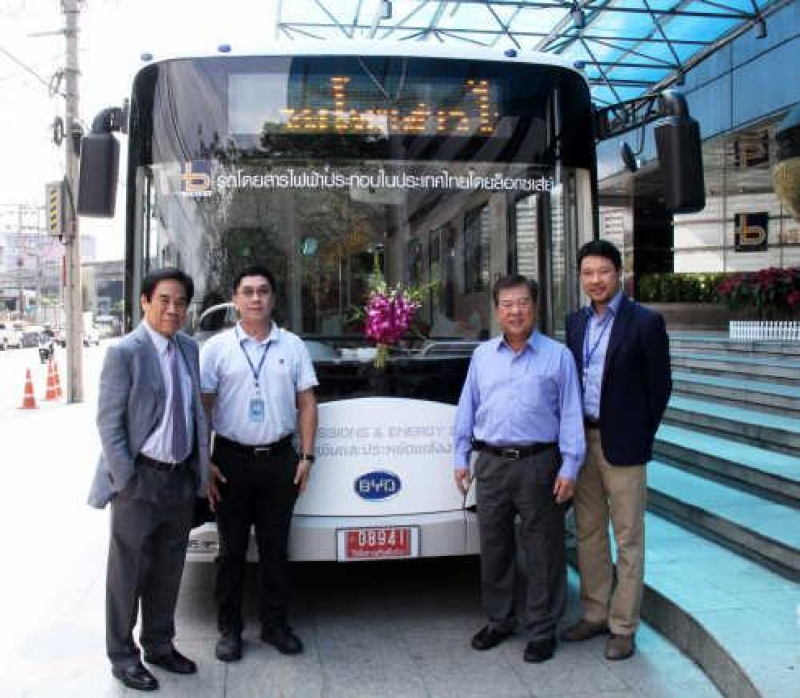
Thongchai Lamsam, president of Loxley revealed that after a feasibility study, the company has formed a joint venture with BYD Auto Industry to establish its assembly plant for electric vehicles. The first electric bus was introduced last Friday.
Similar to the imported model, it is a low-floor K9 electric bus with a length of 12 metres. Its body is made of aluminium alloy, so it has lower weight and is rust free. Its driving system is an 180 kw AC electric motor, yielding about 250 horsepower. It is equipped with an air suspension system, and the battery used is Lithium Fe, with a capacity of 324 kw per hour and a charging time of approximately 5 hours. It should yield a driving range of over 250 km per single charge. Therefore, average use of electricity is approximately 1.2 kwh/km, or about Bt4 per kilometre, with a top speed of 70 kmh.
Battery charging from 0-50 per cent requires 39 minutes, or 5 hours to charge from 0-100 per cent. The useful life of a battery is 6,000 times of charging.
Thongchai said that its fuel tank capacity of 120 litres with zero emissions would help reduce CO2 emissions by up to 100 tonnes a year. Another key feature is electric vehicles have 50 per cent lower fuel consumption than NGV and three times less than diesel engine vehicles. The low-floor electric bus is also convenient for people with disabilities, offering a maximum capacity of 29 seats and space for one wheelchair.
“With the global warming concern, Loxley has placed an importance on alternative energy through the continued development of solar power, wind power, waste to energy and electric vehicles,” Thongchai said.
For electric buses, Loxley will approach target customers including state enterprises, schools and universities, while customers for electric cars will include government agencies, state enterprise, rental car companies, metered taxis and hotels.
