
Media sector outlines concerns for this year


Play
AMID A BACKDROP of economic turbulence across the world, the expectation of further severe drought remains a key concern in the domestic agricultural sector, and therefore also among media businesses that rely on confidence on the part of both consumers a
However, media experts suggest that this year’s full launch of the Asean Economic Community (AEC) will open more doors for out-of-home media in the provinces, while the arrival of fourth-generation wireless broadband is expected to boost online business as well as advertising spending via this new form of outlet.
“There are several issues that we are concerned about for this year’s media business, such as global economic pressure, weak domestic consumption and particularly the impact from severe drought on the agricultural sector,” said Pathamawan Sathaporn, managing director of Mindshare Thailand, the country’s biggest media agency in terms of advertising-investment management. Given those factors, consumer confidence could be dented, while major advertisers would continue to be more cautious in investing in advertising, she said.
Meanwhile, an analyst at KGI Securities (Thailand) suggested that weak and fragile private consumption was likely to continue this year, mainly due to high debt and severe drought.
Overall advertising expenditure is expected to see growth of only 3-6 per cent from last year, which is based on the official economic-growth forecast of 2-4 per cent for the Kingdom.
Pathamawan said her company hoped the economic situation would improve because of the government’s mega-infrastructure investment and economic-stimulus packages.
Asked about the ad sector’s expected rises and falls this year, the media expert said print media would continue to go downhill, with magazines and newspapers losing further market share because advertisers are likely to relocate their messages to digital media and digital-TV channels.
Fuelled by intense competition in the TV industry, digital television is still on the rise, she said, adding that TV is also playing a key role in the media industry.
Advertisers are still putting weight on spending their budgets via TV channels in order to engage and communicate with mass audiences, she explained.
“Content is always king [if you are] to win the game. Big reality shows will continue to dominate prime time on major broadcasters like Channel 7 and Channel 3. International formats, big and small, should continue to be popular among all broadcasters, and prices of sponsorships will continue to increase due to heavy licensing and production costs,” the managing director said.
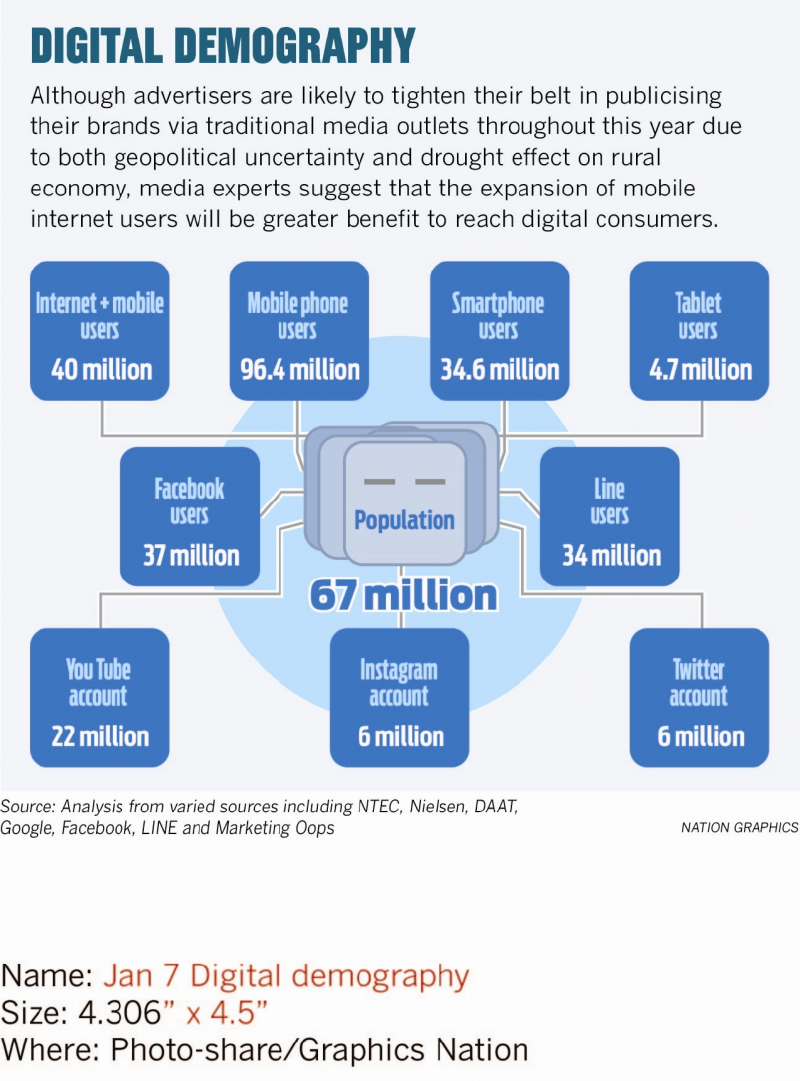
Apart from digital-TV business, online and out-of-home media are also on the rise, with the increase in the number of mobile |Internet users via smart phones |a key driver in this regard.
With the arrival of 4G wireless broadband, the number of mobile Internet users in the provinces is also expected to expand, and social-media usage will follow suit, she said.
“This development opens more doors for brands to collect real-time data generated by consumers who are connected with online media,” Pathamawan added.
According to analysts from various sources – including the Digital Agency Association of Thailand, Google, Nielsen Thailand, Facebook, Line, Marketing Oups and the National Electronics and Computer Technology Centre – there are now 96.4 million mobile phones in use in the Kingdom, of which 48.2 million are smartphones.
Consumers are online for an average of almost four hours day.
“Out-of-home media remains a key channel to create brand awareness, recall and familiarity for consumers. Today’s consumers spend more than 10 hours a day outside their homes, up from just eight hours five years ago,” said Surachet Bumrongsuk, Kinetic Worldwide (Thailand)’s country manager.
Out-of-home media operators – including outdoor, transit and in-store media – anticipate a healthy expansion both in Bangkok and upcountry locations.
In Bangkok, transit media are a key driver because of the extensions of the BTS and MRT lines, while an expansion of major upcountry retailers, particularly in second- and third-tier cities, opens more doors for brands on the shelves to attract consumers, he said.
