
‘Monetary policy alone can’t fix economies’


Play
GREATER VOLATILITY is anticipated in the global financial market as negative interest rates are deemed necessary for some countries like Switzerland to maintain economic stability.
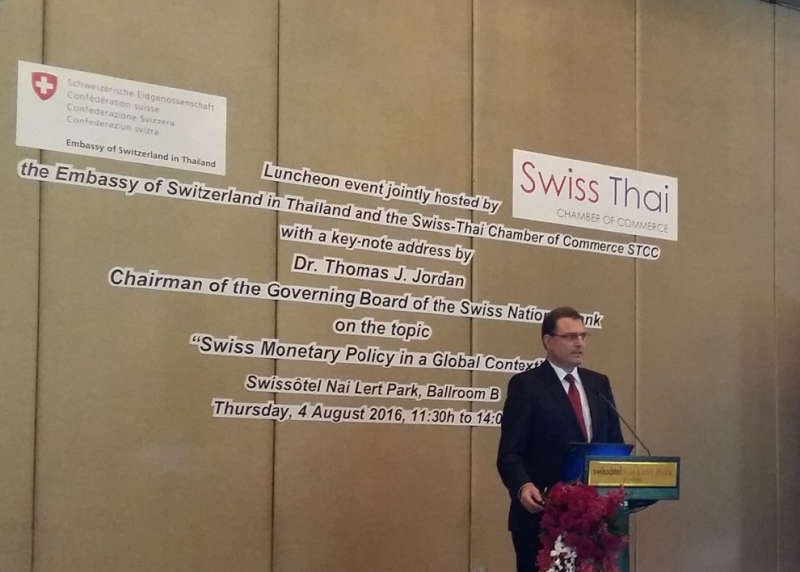
“It’s a very different environment to conduct monetary policy,” said Thomas Jordan, chairman of Swiss National Bank, at a luncheon talk hosted by the Swiss Embassy and the Swiss-Thai Chamber of Commerce last week. The policies for now are “necessary to achieve our mandate”.
Switzerland is one of the countries to have witnessed huge capital inflows since the global financial crisis, as its currency, the Swiss franc, is considered a safe haven. The franc has kept appreciating since, destroying the country’s export and tourism competitiveness. Since January 2015, the central bank has tried to maintain currency equilibrium through a negative interest rate and intervention in the foreign exchange market. At present, a minus 0.75 per cent rate is imposed on bank deposits in Swiss banks.
Last week, the Bank of Thailand maintained its policy rate at 1.5 per cent. Though the baht has appreciated by 3.2 per cent so far this year against the US dollar due to $5 billion in inflows to Thai shares and bonds, having a weaker baht would not help boost exports given the weak global demand. In April 2009, the policy rate was cut to a record low of 1.25 per cent.
In response to low growth, the Bank of England cut rates last week by a quarter point, to 0.25 per cent, expanded its quantitative easing scheme and introduced a new funding scheme for banks. The Reserve Bank of Australia also cut its rate to a record low, in order to boost growth.
Moody’s Analytics expects the Reserve Bank of New Zealand to cut its official cash rate by 25 basis points at a meeting this week and further cuts are anticipated this year.
In his speech titled “Swiss Monetary Policy in a Global Context”, Jordan noted that whenever something happens in the world, the franc appreciates, the latest case was the British referendum vote to leave the European Union. This has encouraged Swiss authorities to continue with their two-pronged monetary policy.
After the June 23 Brexit vote, the pound has lost 10 per cent against the US dollar and the franc has appreciated at the same rate.
“It is very hard to figure out the impacts, but uncertainties have increased. This is what businesses that invest in the UK and the EU must consider,” he said.
Aside from the impact on the currency, Swiss banks’ share prices have also taken a hit. The impact on Switzerland’s economic growth will depend on “the end result of negotiations between the UK and the EU”. The growth rate was affected by the strong appreciation of the franc in 2011 and 2015.
He also expressed concern over the growing assets of central |banks – including Thailand – in |the past few years, as monetary |policies are being used as a tool |to alleviate economic challenges. Hong Kong’s assets are now 140 |per cent of GDP. Low or negative rates can stay for some time due to low inflationary pressure. Switzerland’s inflation is expected to return to the positive territory only in 2017, if oil prices stabilise at the current level.
Jordan admitted that monetary policy has its own limits. For |now, all are convinced that they could support global growth, but this is not sustainable in the long term.
“On the global scale, monetary policy alone cannot improve the economy. We need structural reforms and the shifting of fiscal policy to support growth,” he said.
