
Meet hears how business adjusts to new era
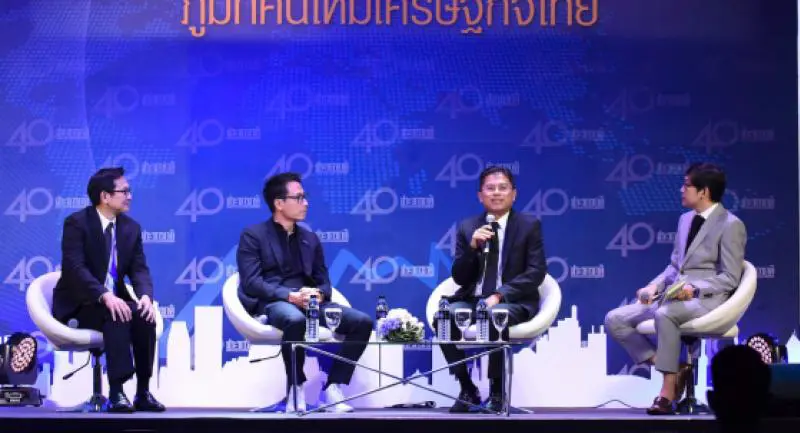


PRIVATE COMPANIES will have to find new ideas to empower their businesses to deal with the disruptions facing the Kingdom’s economy, according to a seminar on “New Landscape of the Thai Economy” organised by Prachachart Turakij newspaper.
Predee Daochai, president of Kasikornbank and chairman of the Thai Bankers’ Association, said the banks needed to prepare themselves to deal with the uncertain environment.
He said the fact that exports were no longer the key drivers of growth in Thailand’s gross domestic product, the prolonged low-interest-rate environment, and the rapid influx of technologies were among the disruptions to banking industry.
Bank liquidity in 2017 is not expected to change because of the low interest rates, but the market believes the United States will raise its rates.
Even though the Bank of Thailand is expected to sustain the current policy rate, the banking industry might have to adjust its rates to reflect actual costs, he said.
Financial technology has come to the banking industry, to which KBank has adjusted by support-|ing fintech start-ups, hoping to attract other start-ups to use KBank as their platforms, he said.
Last week, Beacon Interface, a start-up KBank had supported, won two prizes at the “Singapore FinTech Festival”. Predee said this was one of the ways KBank was attempting to deal with the new economic landscape.
Chanon Ruengkrittiya, chief executive officer and president |of Ananda Development, said |his company looked at disruption |as an opportunity to change the |company’s mindset.
Many industries are facing a sharing economy, where, for example, Airbnb has become the world’s largest provider of rooms, while Ford is changing from auto manufacturer to drive solution, following to a rising sharing economy. The sharing economy could happen in condominium development, and Ananda Development should adjust to this reality, he said.
Auttapol Rerkpiboon, senior executive vice president for the |Oil Business Unit at PTT, said the company was at a crossroads between internal-combustion and electric vehicles, but timing and technology would determine the speed of EV adoption in Thailand.
Energy demand continues to grow, with imports accounting for half of energy consumption. Thailand’s energy efficiency is still low despite its limited resources, so PTT has changed its mindset from supply side to demand side in response.
He said PTT believed that disruption would come with new platforms, and as a result its petrol stations had been changed into mini community malls to ride the new landscape of the economy and consumer behaviour.
