
KBank appoints 4th president as it targets global markets


KASIKORNBANK HAS promoted senior executive vice president Pipit Aneaknithi as its fourth president with the hope of strengthening its presence in international markets, said Banthoon Lamsam, chairman of the board and chief executive officer.
Pipit currently oversees KBank’s world business division.
The current three presidents are Predee Daochai, Teeranun Srihong and Kattiya Indaravijaya, with Pipit’s role as the fourth president to become effective on January 1.
Pipit will also serve as bank director.
Banthoon said each president had expertise in a specific area. For example, Teeranun has overseen financial technology and how to leverage technology for the bank.
“As you see, we are in the international market, and we need people who can empower the bank abroad. The global market today is in [a period of] rapid change and broadening trade,” he said.
KBank will next year upgrade its Chinese branches to locally incorporated institutions (LIIs) and open a fourth branch in Shanghai. Banthoon said KBank planned to spend six or seven months on the upgrade, as the Chinese authorities there had to conduct new audits before granting the necessary licences.
China is a large economy, and Thai businesspeople who have exposure there must become more competitive to survive in that market.
Banthoon believes that if the United States goes ahead with the controversial policies apparently favoured by President-elect Donald Trump, it could result in trade barriers.
However, that is a political matter and Thailand is not directly involved, and this country should concentrate on making itself stronger rather than worrying about China-US relations.
China has problems of its own but is quite capable of managing them, while Thailand has chosen to fuel its economy by injecting money into it.
Meanwhile business operators and all levels should change their methods of working, he said. KBank has adapted itself to ride such challenges as disruptive technology.
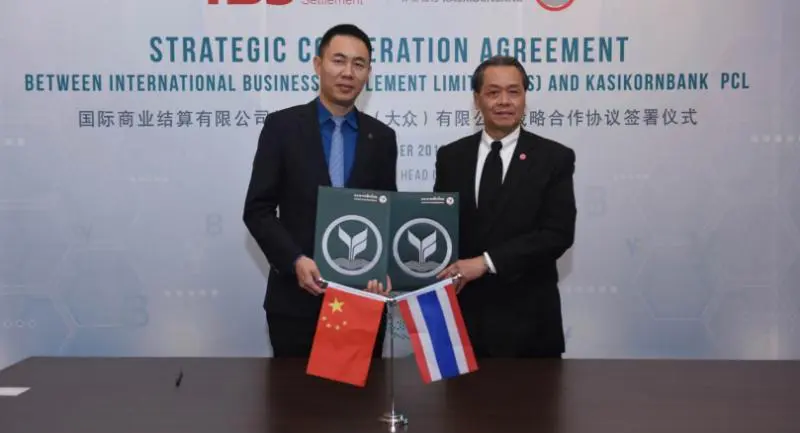
The fourth-largest bank by assets yesterday signed a memorandum of understanding with International Business Settlement Co, a Chinese financial-technology giant, to develop a real-time Sino-Thai settlement system based on the Next Generation Settlement Network (NGSN).
Trade between Thailand and China will be valued at Bt2.3 trillion by the end of this year.
Pipit said KBank would operate in the international market from now on with a combination of physical and digital platforms.
The physical platform is an essential element as it shows the bank’s identity and that it is complying with the regulations of each country. But at the same time, KBank will use the digital platform to accommodate its customers, he said.
