
NBTC awards Bt13 billion contracts to narrow digital divide
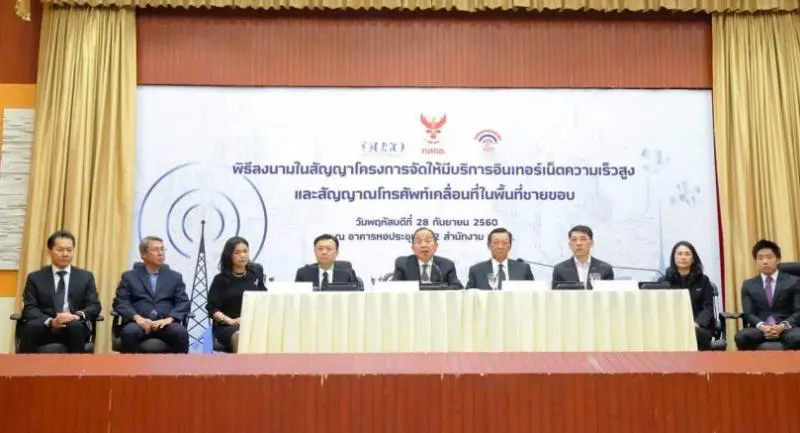


THE National Broadcasting and Telecommunications Commission (NBTC) yesterday signed eight contracts worth Bt12.989 billion with five winners of its recent e-auction to provide a low-fee fixed broadband Internet service, as well as a cellular service, to 3,920 border villages.
NBTC secretary-general Takorn Tantasith said after the signing ceremony that the project, which was aimed at bridging a digital divide in the country, was expected to help further improve Thailand's global competitiveness ranking, as evaluated by the World Economic Forum.
The WEF’s 2017 report card on competitiveness, released on Wednesday, sees the Kingdom climb two notches to 32 on its index of 137 countries.
The WEF report cited factors such as improvements in infrastructure, a rising number of people using mobile phones, and a stronger macroeconomic environment for the country’s improved ranking. Government investments in infrastructure projects have paid off and the private sector has also contributed, it said.
The five bid winners are TOT, CAT Telecom, True Internet Corporation, TrueMove H Universal Communication and Interlink Telecom.
The villages in the project will be able to access broadband Internet services at a minimum connection speed of 30 megabits (Mbps) per second, at a monthly fee not exceeding Bt200.
The broadband service will have to get the service off the ground in at least 588 villages before the end of December, before expanding to cover an additional 2,352 villages by April next year.
The remaining villages will be covered by August next year. These 3,920 villages have 775,027 households.
Two so-called Universal Service Obligation (USO) mini packages will be made available to the villages under the project.
One package will offer a connection speed of 15 Mbps with a monthly fee not exceeding Bt150, and the other, a connection speed of 10 Mbps for no more than Bt100 a month.
The winners of the broadband contracts are required to provide a free public WiFi service in 3,149 spots in all the villages that come under the project; the service will be free for five years.
The regulator developed the project under its USO funding scheme. The project was split into five zones, four broadband internet service contracts and four mobile phone service contracts.
For the provision of the broadband Internet service, True Internet won the contract worth Bt2.812 billion to provide the service to border villages in the project’s zone 1 of the northern provinces.
TOT won the contract worth Bt2.103 billion to provide the service in the northern provinces zone 2, and the contract worth Bt2.492 billion to provide the service in the northeastern provinces.
Interlink won the contract worth Bt1.868 billion to provide the service to central and southern provinces, plus Narathiwat, Pattani and Yala, and four amphurs in Songkla.
According to Interlink, the signing with the NBTC boosted the value of the projects in its backlog to Bt3.117 billion, up from Bt1.249 billion at the end of the second quarter of this year.
For the provision of the mobile phone service, TOT won the contract worth Bt1.889 billion to provide the service in the northern provinces zone 1, while TrueMove H won the contract worth over Bt786.549 million to provide the service in the project’s zone 2 of the northern provinces.
TrueMove H won the contract worth over Bt532 million to offer the service in the northeastern provinces.
CAT won the contract worth Bt504.4 million to offer the service in the central and southern provinces, plus Narathiwat, Pattani, and Yala, and four amphurs in Songkla.
Takorn said the NBTC was expected to call for bids for the second phase of this same project in November.
The watchdog is expected to spend Bt13 billion on the development of the second phase, which will cover around 14,000 rural villages.
The NBTC is expected to sign the contracts with the bid winners for the second phase in January and the project development is expected to be completed in December 2018.
Interlink's managing director Nuttanai Anuntarumporn said yesterday that the company was keen to participate in the bidding for the second phase.
