
Japanese investment shifts as Singapore takes FDI lead


Japan’s share of Thai FDI is shrinking, but a rebound in flows and rising BOI applications point to restructuring rather than an exit.
Japanese investors are not abandoning Thailand, but their role in the economy is changing as Singapore and China gain ground, the automotive sector moves towards electric vehicles and Japanese companies redirect new capital into digital and higher-technology industries.
The question of a possible Japanese retreat intensified in mid-August after a senior Toyota Motor Thailand executive publicly questioned whether the advantages accumulated by Thailand’s automotive production base over more than 60 years would remain intact over the next 10 to 20 years.
Indonesia has also publicly courted manufacturers with offers of wide-ranging support, adding to concerns that Japanese companies deeply embedded in Thailand’s economy could begin shifting production elsewhere in Southeast Asia.
However, data from the Bank of Thailand, the Board of Investment and the Department of Business Development do not point to a broad Japanese withdrawal. Instead, they show a structural reset: Japan’s relative dominance is declining, annual capital flows have become more volatile and investment priorities are moving towards new industries.
Singapore takes lead in Thailand’s FDI stock
Thailand’s total foreign direct investment stock stood at US$405.80 billion at the end of the first quarter of 2026, equivalent to about 13.4 trillion baht at an exchange rate of approximately 33.1 baht to the US dollar.
Singapore accounted for US$103.67 billion, or 25.5% of the total, overtaking Japan as Thailand’s largest source of accumulated FDI by country for the first time.
Japan’s FDI stock stood at US$100.55 billion, representing 24.8% of the total. Japan had remained ahead of Singapore in the previous quarter.
The change forms part of a longer-term decline in Japan’s relative share of investment in Thailand. Its proportion of accumulated FDI fell from about 35% in 2016 to 30% in 2024 and 24.8% in the first quarter of 2026.
Department of Business Development figures nevertheless present a different side of the relationship.
From 2022 through the first half of 2026, Japan remained the largest source of accumulated investment approved under Thailand’s foreign-business regulations, with 323.20 billion baht across 815 approvals.
Singapore followed with 205.05 billion baht, while China recorded 129.44 billion baht.
The apparent difference reflects the distinct scope of the datasets. The Bank of Thailand measures the country’s overall FDI position, while the department records investment linked to foreign businesses authorised to operate under the relevant legislation.

Japanese net inflows weaken before rebound
Japan’s position weakened more sharply when measured by actual net investment flows during 2025.
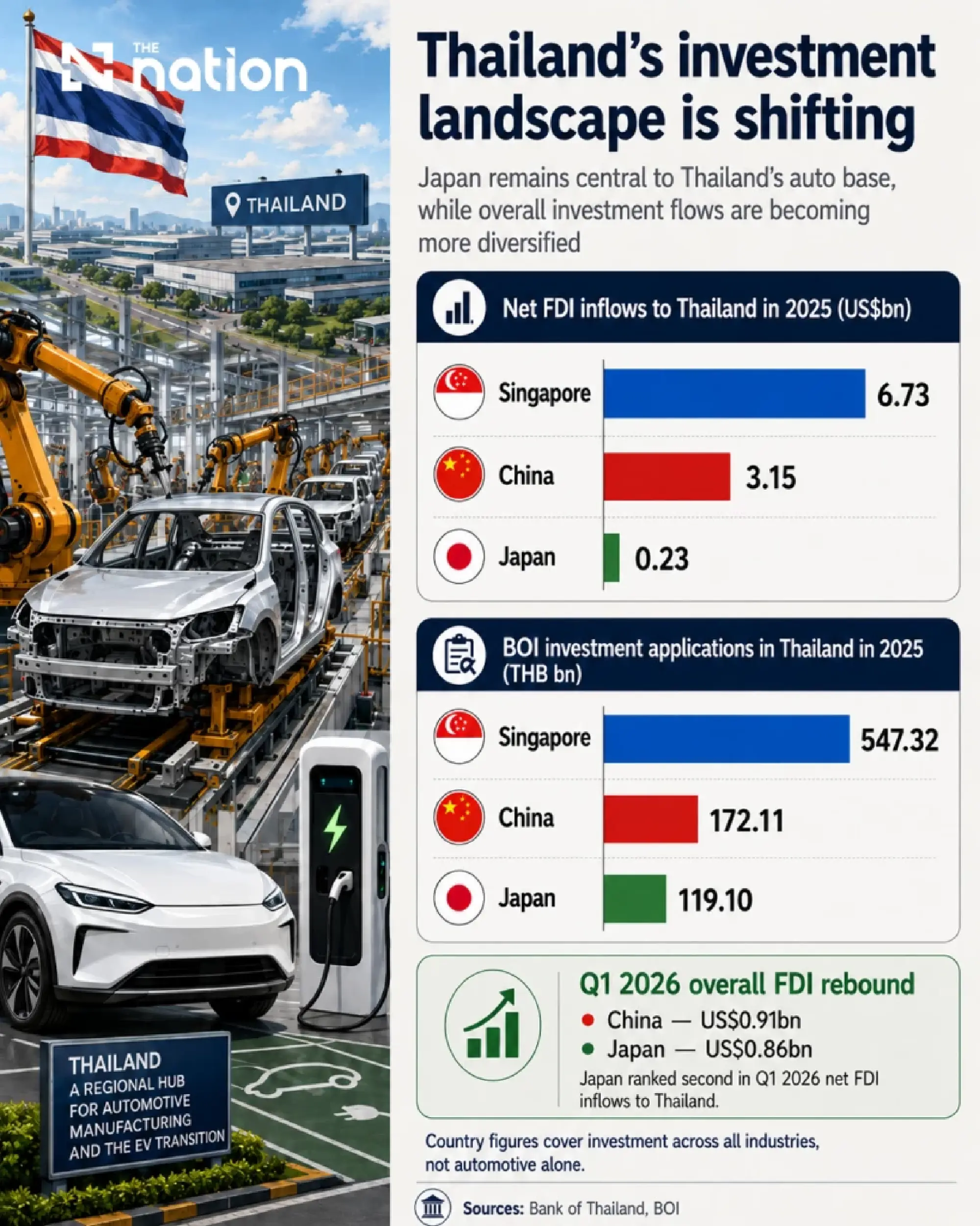
Bank of Thailand data showed Japanese net FDI of US$230 million, or approximately 7.6 billion baht, for the year. This represented only 1.2% of Thailand’s total net FDI inflow of US$18.53 billion and placed Japan ninth among individual economies.
Singapore recorded US$6.73 billion in net investment during the same year, while China contributed US$3.15 billion.
Japanese net investment was negative in the second and third quarters of 2025 before returning to positive territory.
The recovery continued in the first quarter of 2026, when Japan became Thailand’s second-largest source of net FDI.
Japanese inflows reached US$864 million, equivalent to 30.4% of Thailand’s total net FDI of US$2.85 billion during the quarter. China ranked first with US$907 million.
The return to positive net investment over the two most recent quarters indicates volatility and restructuring rather than a steady withdrawal of Japanese capital.
BOI applications contradict exit narrative
Board of Investment data also provide a counterweight to concerns about declining Japanese investment.
Japanese investors submitted 311 applications for investment promotion in 2025, with a combined project value of 119.10 billion baht. This was the highest level for several years and more than double the 49.15 billion baht recorded in 2024.
The BOI approved 248 Japanese projects worth 67.16 billion baht during 2025.
The BOI figures should not be treated as equivalent to the Bank of Thailand’s FDI data.
Bank of Thailand figures represent net investment after transactions such as capital withdrawals and repayments of loans between related companies have been taken into account.
BOI figures, by contrast, record the proposed value of projects applying for or receiving investment-promotion privileges. Project values may therefore be approved before all the corresponding capital enters Thailand.
Together, the two datasets suggest that established Japanese investment is being restructured while companies continue to prepare new projects.
Japanese capital moves into digital industries
The industries attracting Japanese capital are also changing.
From 2021 to 2023, electrical appliances and electronics were among the main areas of Japanese interest under BOI investment-promotion applications.
Machinery and vehicles moved into first place in 2024 and remained the leading category in 2025. The value of Japanese applications in the sector rose from 11.30 billion baht in 2023 to 33.83 billion baht in 2025.
By the first quarter of 2026, digital investment had become the largest category, with Japanese applications worth 14.81 billion baht.
Department of Business Development data showed that contract manufacturing services remained the largest area of Japanese investment, attracting 152.46 billion baht.
Computer-related services, including software development, data centres and cloud operations, ranked second among foreign-investment service categories overall, with accumulated investment of 125.21 billion baht.
The figures point to a gradual broadening of Japanese investment beyond the industries that drove Thailand’s earlier manufacturing expansion.
EV transition reshapes automotive investment
The slowdown in traditional Japanese investment has coincided with a major transition in Thailand’s automotive industry, historically the centre of Japanese manufacturing activity in the country.
The industry’s move from internal-combustion engines towards electric vehicles has opened the market to Chinese manufacturers investing in EV assembly, electronic components and associated supply chains.
Chinese capital subsequently rose to become Thailand’s second-largest source of net FDI in 2025 and the largest in the first quarter of 2026.
Japanese automotive companies, meanwhile, must balance their long-established strengths in combustion-engine production with the need to compete in electric and other lower-emission technologies.
A weaker yen has also raised the cost of overseas expansion for Japanese companies. At the same time, several corporate groups have been restructuring and consolidating production rather than investing in substantial new capacity.
Japanese investment in Thailand is consequently moving from a period of sustained expansion towards a more mature phase of selective investment, restructuring and technological upgrading.
Thailand’s investment landscape becomes more diverse
Thailand continued to attract historically high levels of foreign investment in 2025, but the sources of that capital became more diverse.
Japan once occupied an overwhelmingly dominant position, particularly in automotive and electronics manufacturing. Newer investment flows now feature a larger role for Singapore, China and Hong Kong.
For Japan, the long-term numbers indicate a decline in relative weight rather than an end to its economic presence.
Its share of accumulated FDI has fallen steadily and its annual net inflows weakened significantly in 2025. However, Japanese investment returned to positive territory in the final quarter of 2025 and rose to second place in the first quarter of 2026.
Japanese companies appear to be balancing the preservation of their established Thai factories and supply chains with slower investment in conventional capacity and greater emphasis on digital infrastructure and advanced technology.


Krungsri sees diversification rather than relocation
Kohei Omori, head of Japanese corporate banking at Bank of Ayudhya, or Krungsri, said there was no evidence of a broad relocation of Japanese production from Thailand.
Some Japanese companies have expanded operations into Vietnam and Indonesia, but Omori described this as part of a regional diversification strategy intended to spread business risk rather than an abandonment of Thailand.
Thailand remains one of the most important Japanese manufacturing bases in Southeast Asia, particularly for the automotive sector and related industries.
Decades of investment have produced an interconnected supply chain and industrial ecosystem that would be difficult to reproduce or replace in another country.
Krungsri has not seen any significant effect on its business plans or financing strategy for Japanese clients as a result of companies expanding elsewhere in the region.
Loans to Japanese corporate clients account for about 10% of the bank’s total lending portfolio.
Krungsri is also supporting investment in industries including semiconductors, data centres and start-ups. The bank provides business-matching services and uses the combined networks of Krungsri and MUFG to support clients seeking further growth across ASEAN.
Japanese companies pushed beyond comfort zone
Visit Limlurcha, vice-chairman of the Thai Chamber of Commerce and president of the Thai Future Food Trade Association, similarly said Japanese investment in Thailand was continuing, although its pace had slowed.
Japanese companies are moving beyond their traditional “comfort zone” by combining established industrial strengths with newer technologies, he said.
In the automotive sector, that includes developing internal-combustion expertise into hybrid vehicle technology, with a focus on fuel efficiency and cost competitiveness against battery-powered electric vehicles.
Visit identified policy stability and continuity, Thailand’s integrated industrial ecosystem, its established supply chain, its strategic ASEAN location and infrastructure supporting high-technology industries as the country’s principal investment advantages.
He also urged Thailand to accelerate negotiations on free trade agreements, noting that neighbouring countries had progressed further in expanding market access.
Thailand’s longer-term challenge, he said, is to advance from a manufacturing base for standard technologies to one capable of producing higher-value and more advanced technologies.
Source: Thansettakij
