
Thailand Unveils "Offer to the World" Strategy for Tech and Green Growth
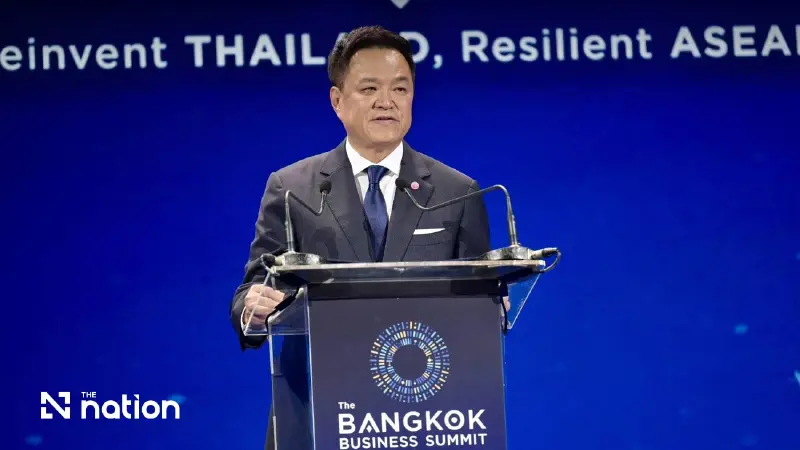


Prime Minister Anutin Charnvirakul vows to overhaul regulatory bottlenecks and reposition the nation as a high-value industrial partner for global investors
- Thailand has launched a new national strategy called "Offer to the World" to reposition itself from a manufacturing hub to a "co-creation partner" for global investors.
- The strategy focuses on attracting high-value investment in three key sectors: Advanced Technology and AI, the Green Transition (clean energy and sustainable infrastructure), and the Longevity Economy (wellness and medical tourism).
- To support this initiative, the government is overhauling thousands of regulations to reduce commercial bottlenecks and is pursuing membership in the OECD to boost investor confidence.
- Future investment approvals will favor proposals that commit to training the Thai workforce, integrating domestic suppliers, and fostering localized research and development.
Prime Minister Anutin Charnvirakul vows to overhaul regulatory bottlenecks and reposition the nation as a high-value industrial partner for global investors.
Prime Minister Anutin Charnvirakul has delivered a resolute commitment to global business leaders, pledging that Thailand will act as a genuine "co-creation partner" rather than a mere manufacturing hub, as part of an ambitious new national investment strategy.
Delivering a keynote address titled "Thailand’s Offer to the World" at The Bangkok Business Summit 2026 on Thursday, Anutin, who also serves as Minister of Interior, outlined a forward-looking agenda designed to attract high-value foreign direct investment amidst severe global market realignments.
The Prime Minister declared that the government is tackling four converging global transitions—geopolitical friction, rapid technological disruption, climate change, and demographic shifts—by converting these pressures into economic opportunities.
"My message to international investors is that Thailand is ready to be more than just a production base or a consumer market. We want to be a partner in building the industries of the future," Anutin told delegates at the Queen Sirikit National Convention Centre. "Don't just come to invest in Thailand; come to build together with Thailand."
Three Pillars for Economic Renewal
Central to the "Thailand’s Offer" framework are three primary growth sectors:
Advanced Technology and Artificial Intelligence: Transitioning Thailand from a net consumer of technology into an innovation hub by prioritising investments that upskill local personnel and enable small and medium-sized enterprises (SMEs) to compete internationally.
The Green Transition: Treating sustainability as a catalyst for capital generation rather than an operational cost. The government intends to draw global climate finance into clean energy grids and resilient infrastructure.
The Longevity Economy: Turning the structural challenge of an aging society into commercial opportunities across wellness, medical tourism, and specialised quality-of-life technologies.
Anutin stressed that international firms entering Thailand do not need to build operations from scratch, citing the country's existing industrial depth across automotive, electronics, food processing, and healthcare clusters.
Slashing Red Tape and Securing OECD Accession
To reassure international business leaders on market predictability and ease of operation, Anutin revealed that the government is systematically reviewing over 7,000 laws and regulations that currently act as commercial bottlenecks.
This regulatory overhaul aligns with Thailand’s ongoing formal bid to accede to the Organisation for Economic Co-operation and Development (OECD). The government views OECD accession as a vital mechanism to elevate national governance, corporate transparency, and regulatory standards to international benchmarks, safeguarding investor confidence over the long term.
Regional Platform and Cross-Sector Integration
The Prime Minister highlighted Thailand’s strategic position as a gateway to the broader ASEAN market, offering seamless access to more than 600 million consumers.
He announced that Bangkok will showcase its commercial and logistical readiness to the international finance community when it hosts the Annual Meetings of the International Monetary Fund (IMF) and the World Bank Group this October.
Additionally, the strategy relies on breaking down traditional industry silos—merging advanced manufacturing with digital systems, linking agriculture with biotechnology, and pairing clean energy production directly with electric vehicle (EV) manufacturing and data infrastructure.
Concluding his address, Anutin reiterated that future investment approvals will favour high-quality capital proposals that commit to training Thai workers, integrating domestic suppliers, and fostering localised research and development.
