
Japan awaits return of islands 70 years after pact with the Soviet Union
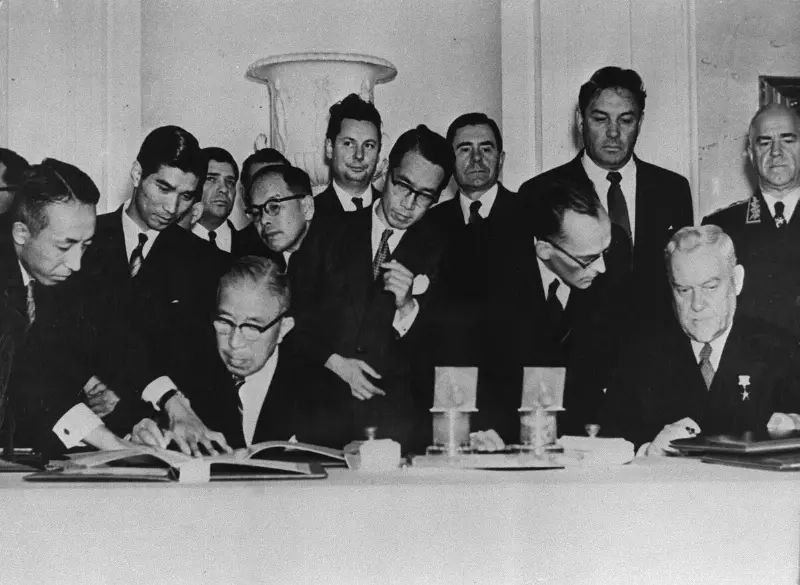


Japan pledges continued contact with Moscow despite suspended peace treaty talks and a Russian decision to end visa-free exchanges involving disputed islands.
- On the 70th anniversary of the 1956 Japan-Soviet Joint Declaration, the return of two islands, Shikotan and the Habomai group, remains unresolved as it was contingent on a peace treaty that has never been signed.
- Prospects for the islands' return are uncertain as Russia has suspended peace treaty negotiations and now considers the territorial issue "settled" in retaliation for Japan joining sanctions over the Ukraine invasion.
- Russia's hardened stance is also influenced by its strategic alignment with China, with both nations recently criticizing Japan.
- Russian President Vladimir Putin recently reinforced his country's claim by visiting the disputed region, linking Moscow's control to the outcome of World War II and blaming Japan for worsening relations.
Japan intends to maintain contact with Moscow over disputed islands, even as Russia’s increasingly firm position leaves the return of two territories uncertain.
The 1956 Japan-Soviet Joint Declaration, which provides for that handover, reached its 70th anniversary on Monday (October 19, 2026).
“We will continue necessary communication with the Russian side and work toward a breakthrough,” Japanese Chief Cabinet Secretary Minoru Kihara said at a press conference on Monday.
He also said, “We take seriously the fact that the Northern Territories issue remains unresolved.”
Under that agreement, a peace treaty formalising the post-Second World War settlement must be concluded before Shikotan and the Habomai group can be transferred to Japan.
They are two of the four disputed island territories collectively called the Northern Territories in Japan.
Moscow’s response to Japan joining Western sanctions over Russia’s 2022 invasion of Ukraine has included designating it an unfriendly country and suspending peace treaty negotiations.
Russia has also decided to scrap the visa-free exchange agreement involving the islands and has reinforced its claim that the territorial issue is settled.
Global circumstances weigh heavily on relations between Japan and Russia, according to Dmitry Streltsov, a professor at the Moscow State Institute of International Relations familiar with Japanese affairs.
He expects no improvement as long as the two countries are on opposing sides.
Japanese Prime Minister Sanae Takaichi’s remarks about a possible Taiwan contingency angered China in 2025.
Beijing has repeatedly used “new militarism” to criticise Japan since then.
Russian President Vladimir Putin and Chinese President Xi Jinping used the same term to criticise Japan in a joint statement in May 2026.
Consideration for China, which has supported Russia during the Ukraine war, is also seen as influencing Moscow’s harder approach to Japan.
Putin linked Moscow’s control of the disputed islands to the outcome of the Second World War when addressing senior officers of the Russian Navy’s Pacific Fleet on Sakhalin in August 2026.
During that visit to Russia’s Far East, his first to Sakhalin in about 13 years, he also blamed Japan for the recent worsening of bilateral relations.
He travelled to Etorofu the following day, making his first visit there since initially taking office in 2000.
The other two disputed islands, Kunashiri and Etorofu, are absent from the declaration.
Their omission meant that the 2018 decision by then Japanese Prime Minister Shinzo Abe and Putin to make it the foundation for peace treaty talks was seen as a move away from Japan’s efforts to recover all four islands.

[Copyright The Jiji Press, Ltd.]
