
Japan's 2025 Osaka Expo technologies enter medical and commercial use


Science Co.'s bathing capsule is installed at six sites, with five units due for a retreat in the United States and a household model under development.
- Cuorips Inc.'s RiHEART, a heart-muscle sheet derived from iPS cells, has been used in the world's first surgical implant of its kind for a heart patient.
- A rescue detector from Matrix Inc. that locates people under debris via IC tags is now being sold commercially to businesses for emergency response.
- Science Co.'s "human washing machine," an automated body-cleaning capsule, is being delivered and installed in commercial facilities like retreats and hot springs.
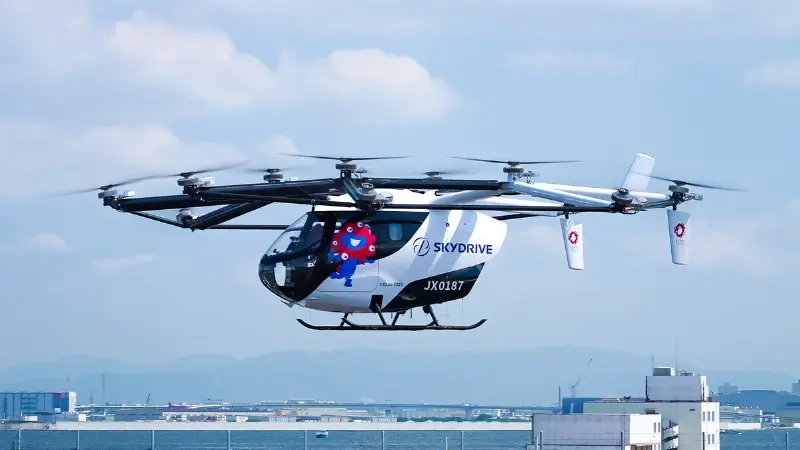
- SkyDrive Inc. is planning to launch commercial flying car services by fiscal
A hospital in Osaka, western Japan, implanted Cuorips Inc.’s RiHEART heart-muscle sheet in a patient in September 2026, the same month Matrix Inc. started selling a rescue detector to businesses.
Both technologies were shown at the city’s 2025 World Exposition.
Made from induced pluripotent stem (iPS) cells, RiHEART is a sheet of heart-muscle cells whose implantation marked the world’s first surgical use of an iPS-derived medical product.
The procedure attracted interest from countries including Indonesia and the United Arab Emirates.
A wait of more than five years is common for patients needing a heart transplant because of severe ischaemic cardiomyopathy.
The condition leaves the heart muscle unable to work properly as blood vessels become blocked.
“This would resolve a hopeless situation,” said Kazuyoshi Hirao, executive vice president of RiHEART developer Cuorips, a startup from the University of Osaka.
RiHEART can help improve heart function if three sheets are attached to the heart.
Together, the sheets provide about 100 million cardiomyocytes, or heart-muscle cells, which promote blood-vessel recovery.
“The challenge is to mass-culture uniform heart muscle cells,” Hirao said of production. “IPS cells are a Japanese-born innovation in basic science. We hope to lead the way in practical application as well.”
Food and elderly care companies are among the approximately 150 businesses supplied with Matrix’s integrated circuit (IC) tags for building entry and exit management.
These users could strengthen their emergency response by adding the detector.
Matrix’s detector works over a range of about 8.5 metres, locating people beneath debris provided they are carrying the company’s IC tags.
The device was among technologies from Osaka’s small factories featured at the 2025 Expo.
“Japan is a disaster-prone country,” said Matrix president Yoshimitsu Tsuji. “We hope our products will be used to rescue as many people as possible.”
Five of Science Co., Ltd.’s “human washing machines” are due for delivery to a retreat facility in the United States.
Accommodation and hot spring facilities are among the six locations where the capsule-shaped device has already been installed.
Fine bubbles clean the user’s whole body inside Science’s capsule.
A predecessor of the machine attracted attention at the 1970 Osaka Expo, with Science presenting an upgraded version at the 2025 event.
Home users are the focus of another Science model now in development.
The company is also targeting elderly care facilities, where the machine could shorten the time needed to provide assistance.
SkyDrive Inc. has plans for flight services in Osaka city and the prefectures of Iwate, Oita and Shizuoka.
The company is aiming to begin commercial operations in fiscal 2028.
SkyDrive’s aircraft maintained stable flight at 100 kilometres per hour in May 2026.
SkyDrive has conducted about 300 demonstration sessions, including flights at the 2025 Expo, where flying cars were promoted as a next-generation form of transport.
