
22 global economic takeaways from IMF–World Bank meetings in Thailand
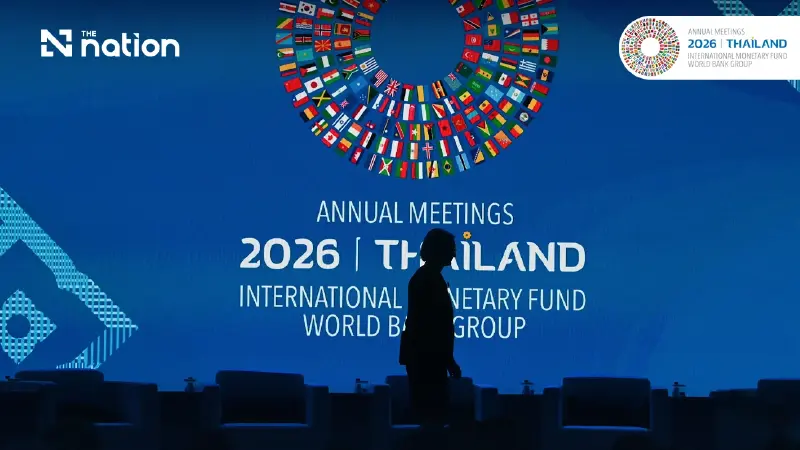


The Bangkok discussions cover artificial intelligence, debt, jobs, climate risks, healthcare and measures to strengthen economic resilience.
- Asia is the primary engine of global economic growth, while developing countries are increasingly trading with one another, marking a structural shift in global trade.
- The IMF urged governments worldwide to tighten fiscal policy by ending blanket cash handouts and advised central banks to maintain restrictive interest rates to combat inflation.
- The AI boom is a significant economic force supporting trade and investment, but its wider productivity gains are still uncertain and it is seen as reshaping jobs rather than eliminating them.
- Key challenges for developing nations include high public debt, rising food prices, and the need to create 1.2 billion jobs for young people, with the World Bank emphasizing private sector growth to create opportunities.
The 2026 Annual Meetings of the International Monetary Fund (IMF) and the World Bank Group began on October 12, 2026, at the Queen Sirikit National Convention Center in Bangkok and are due to close officially on October 18.
Global financial and fiscal leaders have held intensive discussions on a range of major economic issues throughout the past week.
Bangkokbiznews has compiled 22 key takeaways from the discussions and presentations at the meetings.
1. Asia remains a main engine of global growth
The IMF launched its latest annual flagship report, “Shaping the Future of Asia: Opportunities and Challenges”, examining the region’s economic growth and achievements over several decades.
Since 1990, Asian economies have accounted for almost two-thirds of global economic growth.
Their contribution has been particularly strong in 2026, reaching a record 68% of worldwide growth.
2. Governments warned to end blanket cash handouts
The IMF launched its World Economic Outlook, entitled “Resilience Under Strain, Urgent Choices”, with a clear policy message to governments and central banks worldwide that fiscal policy needs to tighten.
Governments need to act quickly to reduce budget deficits and contain public debt, end blanket cash handouts and restrict cost-of-living subsidies to vulnerable groups within clearly defined timeframes.
On monetary policy, central banks need to maintain their independence and hold interest rates at sufficiently restrictive levels to prevent rising prices from spiralling out of control over the long term.
3. The AI boom provides support for Thai exports
Although global growth remains uneven, the IMF noted that Thailand, as a member of the ASEAN-5 group of economies within the Association of Southeast Asian Nations (ASEAN), benefits indirectly through technology supply chains.
Investment in artificial intelligence (AI) hardware infrastructure by leading Asian producers such as South Korea and Taiwan has provided some support for Thai manufacturing and exports.
AI has become an important contributor to global trade and economic growth.
Between 2023 and 2025, world trade expanded by a cumulative 8.3%, while trade in AI-related goods rose by 29%.
Excluding those goods, global trade growth would have been just 4.6%.
4. Tackling poverty requires more than financial assistance
The World Bank argued that reducing poverty requires a focus on creating opportunities through work, beyond providing financial assistance.
With government budgets and aid resources under pressure, it is adjusting its strategy to bring in greater support from philanthropy and the private sector.
Support through official development assistance (ODA) currently amounts to one-fifth, or US$15–20 billion annually, alongside efforts to mobilise private capital.
The private sector is the main engine of global job creation, accounting for 90%.
5. Small AI offers opportunities for developing countries
Developing countries do not always need the largest or most advanced AI technologies, according to the World Bank.
Under its “Small AI” approach, the emphasis is on adapting technology to local circumstances to deliver productivity gains and economic growth.
The approach addresses infrastructure constraints associated with large language models (LLMs) in developing countries by focusing on practical applications.
Examples include remote screening for skin diseases in Indonesia and using photographs to analyse crop diseases in India.
6. Helping small businesses withstand disasters
The climate crisis is raising costs and increasing the vulnerability of Thai businesses, particularly through flood damage and pressure to adapt quickly to a low-carbon economy.
Access to finance and insurance remains a key challenge in building business resilience.
The World Bank proposed integrating policies for micro, small and medium-sized enterprises (MSMEs) with green finance and insurance mechanisms to improve disaster preparedness and maintain competitiveness.
This is particularly relevant to small businesses in flood-prone areas with limited resources to adapt.
7. Developing countries trade more with one another
The World Bank highlighted structural changes in global trade over the past 30–40 years.
Trade has quadrupled, while developing countries’ share has doubled.
Half of developing countries’ trade is now conducted with one another, reflecting a shift from earlier patterns of dependence on developed export markets.
The figure given for ASEAN’s trade within the region was 50–55%, reflecting stronger regional trading ties than those in South Asia, Africa or Latin America.
Although 100 bilateral and multilateral trade agreements have been signed worldwide over the past decade, inadequate implementation remains a major problem.
The World Bank therefore called for faster action to reduce trade barriers.
8. Jobs needed for 1.2 billion young people
The World Bank highlighted that 1.2 billion young people in emerging economies will reach working age in the coming years.
With adequate support for healthcare, the environment and education, they could become a significant force for economic growth.
MSMEs account for 75% of employment in developing countries.
The World Bank has launched a new strategy to help these businesses obtain finance, improve competitiveness and create sustainable local jobs, particularly in low-income or conflict-affected countries.
9. ASEAN needs faster integration as global trade fragments
Despite successive shocks from the pandemic, wars and energy prices, the global economy has proved more resilient than expected.
This partly reflects the private sector’s flexibility and rapid adjustment, alongside policy buffers accumulated by emerging market economies.
The World Bank argued that Thailand and ASEAN need to accelerate regional economic integration, remove non-tariff trade barriers and strengthen supply chains and digital infrastructure links.
Building on existing regional trading ties would improve resilience and create opportunities as global trade becomes increasingly fragmented.
10. Four strategies to improve MSME access to finance
MSMEs form a foundation of developing economies, accounting for 90% of businesses and 75% of employment, according to the World Bank.
Over the next 10–15 years, 1.2 billion people in developing countries will reach working age, while their economies are expected to create only 420 million jobs.
To address these constraints, the World Bank proposed four strategies using data and digital technology to support MSMEs.
These involve making businesses visible within the system, connecting them with markets and services, reducing barriers to doing business and widening access to finance.
11. Limited fiscal space poses difficult budget choices
Budget constraints and high public debt present another major challenge for developing countries.
Successive global crises over the past decade, from COVID-19 to wars and tensions in the Middle East, have left many governments with less fiscal space.
The World Bank noted that governments must decide how to allocate resources between infrastructure essential for economic development, particularly AI-related infrastructure, and investment in human capital, such as education.
Both are important for long-term growth.
12. International partnerships advance universal health coverage
The World Bank is working with Japan’s government, the World Health Organization (WHO) and global partners to advance universal health coverage (UHC) through “country compacts”.
These allow countries to define their own needs while drawing targeted financial support from partners such as Gavi and the Global Fund.
A UHC Knowledge Hub has also been established to bring finance and health ministries together for a full year to plan reforms that make health financing more efficient and self-reliant.
13. “Great Repression” places the debt burden on savers
With public debt rising worldwide, the IMF warned that governments in advanced economies could return to policies that helped reduce debt after the Second World War.
Known as “financial repression”, these use financial policies and regulations to keep government borrowing costs below market levels, with savers bearing the burden indirectly.
Rather than relying on announced tax increases or explicit austerity measures, this approach operates through the financial system.
Regulations encourage, or pressure, banks and financial institutions to hold more government bonds than market conditions would otherwise justify.
Governments obtain cheaper funding, while people receive lower returns on their deposits and investments.
14. Energy risks continue to weigh on Asia-Pacific
The IMF described Asia-Pacific economies as remarkably resilient despite global uncertainty, with their economic direction shaped by three forces:
- The energy price crisis has significantly affected a region dependent on imports of oil and natural gas from the Middle East. Energy dependence amounts to 4% of gross domestic product (GDP) in Asia-Pacific and 7% in ASEAN, with almost half requiring imports.
- The technology and AI boom has accelerated since mid-2025, supporting exports, investment in data centres and huge demand for semiconductors.
- Trade and tariff pressures following tariff increases in early 2025 have proved more manageable than expected for many countries, helped by export market diversification and expanding intraregional trade.
15. Human capital development must widen access to AI
The IMF argued that countries should go beyond adopting AI and promote its use throughout the economy and among all population groups so that the economic benefits are widely shared.
Developing human capital is crucial for ASEAN.
The highest priorities were described as covering four areas, with workforce upskilling, refocusing the education system and lifelong learning listed.
AI is reshaping jobs rather than eliminating them.
Although demand for workers in roles that AI can replace initially fell by 10%, that decline has begun to stabilise.
Demand for workers equipped to work with AI, meanwhile, is clearly increasing, suggesting a change in working practices rather than the wholesale replacement of labour.
16. AI spreads rapidly while wider productivity gains remain uncertain
The IMF described AI as a technology spreading at unprecedented speed, offering significant growth opportunities to countries connected to its value chain.
However, only a minority of countries have access to those opportunities, while financial stability risks are becoming an issue for policymakers to monitor.
The world remains at an early stage of the transition.
Most visible gains involve improvements in individual efficiency rather than economy-wide productivity.
The discussion referred to “Amara’s Law”, which holds that people tend to overestimate the short-term impact of new technology and underestimate its long-term effects.
17. Economic risks demand careful monetary and fiscal policy
The region’s outlook faces downside risks from prolonged tensions in the Middle East, limited energy reserves and El Niño.
Public debt also remains above pre-COVID-19 levels.
The IMF noted that fiscal deficits have narrowed governments’ room for manoeuvre, while high debt and rising global bond yields require more careful fiscal management.
The IMF emphasised that regional central banks should preserve price stability and operational independence.
Fiscal policy should pursue growth-friendly consolidation guided by the principle “Protect people, not prices”, replacing broad energy price subsidies with targeted support.
18. Fed gives no guidance on remaining rate decisions this year
US Federal Reserve Chair Kevin Warsh offered no indication of the direction of interest rates at the year’s two remaining policy meetings.
He maintained that he would neither predict nor prejudge decisions before meetings of the Federal Open Market Committee (FOMC).
The Fed will assess actual economic conditions, including growth, employment and inflation, before making decisions in October and December, following its September rate increase.
Global economic developments over the past month have remained in line with its expectations.
19. AI affects demand first while productivity gains take time
Warsh also discussed AI’s effects on the economy, noting that its immediate impact is on demand as investment in the technology increases spending within the economic system.
Its benefits for production efficiency and economic productivity are “not immediately apparent”, making the technology an important consideration for central banks, particularly because of its potential effects on inflation.
Over the medium term, AI is expected to provide a positive supply-side impulse, increasing productivity and prosperity in countries able to use it effectively.
20. Raising rates now is better than sharper increases later
High public debt remains another major risk, particularly in advanced economies.
Developing countries also face rising interest costs, leaving governments with fewer resources for economic development and public support.
Inflationary pressures have pushed government bond yields higher.
Ten-year yields in the United States, Germany and Japan have reached their highest levels since 2002, 2009 and 1996 respectively.
IMF Managing Director Kristalina Georgieva supported the stance of the Fed, the European Central Bank (ECB) and the Bank of Japan (BOJ).
She argued that raising rates now was preferable to allowing inflation to intensify and requiring larger increases later.
21. Food price pressures threaten fiscal stability
The IMF noted that the world has faced five successive major crises over the past five years, beginning with COVID-19 and most recently El Niño, which has placed pressure on food security on every continent.
Global food prices are rising again, with rice up 50%, wheat 37% and soybeans 21%.
Drought and higher temperatures have severely affected the Sahel, the Horn of Africa, Central America, South Asia and Southeast Asia.
22. Citizens are the most important force against corruption
Corruption was another subject discussed at the meetings.
Although the IMF previously gave it considerable attention, it featured less prominently in its latest assessment of Thailand’s economy.
Georgieva identified citizens working together to hold their governments accountable for the exercise of power as the most important force against corruption.
The IMF continues to monitor governance, even when it does not produce dedicated coverage in its reports every year.
It considers transparency insufficient without mechanisms that hold those in power accountable for their decisions.
